In today’s digital world, passwords protect almost everything—email accounts, social media profiles, banking apps, cloud systems, and corporate networks. But what happens when attackers try every possible password combination until they succeed? That’s exactly what a Brute Force Attack is all about.
Despite being one of the oldest hacking techniques, brute force attacks are still widely used because they work—especially against weak passwords and poorly protected systems. With modern computing power, automated tools, and GPUs, attackers can attempt millions or even billions of login attempts in a very short time.
In this detailed guide, we’ll explain what a brute force attack is, how it works, why hackers use it, types of brute force attacks, real-world examples, and how both professionals and everyday users can protect themselves.
What’s a Brute Force Attack?
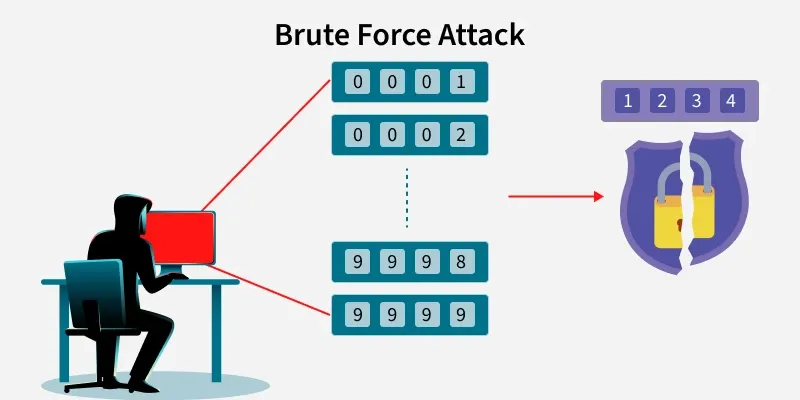
A Brute Force Attack is a trial-and-error hacking method where an attacker systematically attempts all possible password or credential combinations until the correct one is found.
Instead of exploiting a software vulnerability, brute force attacks target human weakness, such as:
- short passwords
- reused credentials
- predictable login details
In its simplest form, a brute force attack involves:
- Choosing a target account or system
- Using automated software to try login combinations
- Repeating attempts until access is gained
Because the process is automated, attackers can test thousands of passwords per second.
What Do Hackers Gain from Brute Force Attacks?
Hackers use brute force attacks because the rewards can be significant. Once access is gained, attackers can exploit systems in multiple ways.
Also Read: What is Linux and is it really secure?
Profiting from Ads or Collecting Activity Data
One common motivation behind a brute force attack is monetization.
Once attackers compromise:
- websites
- user accounts
- servers
They can inject ads, redirect traffic, or secretly collect browsing activity data. This stolen data is often sold or used to generate advertising revenue without the victim’s knowledge.
Stealing Personal Data and Valuables
A successful brute force attack can expose:
- email accounts
- online banking credentials
- social media profiles
- cloud storage
With access to these accounts, attackers can steal:
- financial details
- identity documents
- private conversations
This stolen data can then be used for fraud, identity theft, or resale on underground markets.
Spreading Malware to Cause Disruptions for the Sake of It
Some attackers are motivated by disruption rather than profit.
After a brute force attack, they may:
- install malware
- spread malicious links
- disrupt services
This can cause data loss, downtime, and operational chaos—especially for businesses.
Hijacking Your System for Malicious Activity
Compromised systems are often used as tools for further attacks.
Attackers may:
- turn devices into botnets
- launch spam campaigns
- conduct distributed denial-of-service (DDoS) attacks
In many cases, victims don’t even realize their system has been hijacked.
Ruining a Website’s Reputation
Websites targeted by brute force attacks may be:
- defaced
- redirected to malicious content
- used to host harmful files
This damages credibility, search rankings, and user trust—sometimes permanently.
Types of Brute Force Attacks
A brute force attack is not a single technique. There are multiple variations attackers use depending on their goal and available data.
1. Simple Brute Force Attack
This involves trying every possible character combination until the correct password is found. It’s slow against strong passwords but effective against weak ones.
2. Dictionary Attack
Instead of random combinations, attackers use lists of common passwords and words, assuming users choose predictable credentials.
3. Credential Stuffing
Here, attackers use previously leaked username-password combinations from data breaches to try logging into other services.
4. Hybrid Brute Force Attack
This combines dictionary attacks with variations like numbers or symbols (e.g., “Password123”).
5. Reverse Brute Force Attack
Instead of trying many passwords for one user, attackers try one common password across many accounts.
Stop Brute Force Attacks Before They Start
Preventing brute force attacks is far easier than recovering from one. Strong authentication practices and proactive security measures significantly reduce the risk of compromise.
Tools Aid Brute Force Attempts
Modern brute force attacks rely heavily on automation.
Attackers use specialized tools that:
- automate login attempts
- bypass simple protections
- scale attacks across thousands of systems
These tools can test millions of passwords rapidly, making manual defense strategies ineffective without proper controls.
GPU Speeds Brute Force Attempts
Graphics Processing Units (GPUs) have dramatically increased the effectiveness of brute force attacks.
Why GPUs Matter
- GPUs can process tasks in parallel
- They outperform traditional CPUs for password cracking
- One GPU can test billions of combinations per second
This means passwords that once took years to crack can now be compromised in minutes if they are weak.
Steps to Protect Passwords for Professionals
Organizations must take a multi-layered approach to protect systems from brute force attacks.
Passive Backend Protections for Passwords
Passive protections work silently in the background.
These include:
- Strong password hashing to prevent readable storage
- Salting passwords to stop precomputed attacks
- Rate limiting login attempts
- Account lockout policies after repeated failures
These measures make brute force attacks slow and impractical.
Active IT Support Protections for Passwords
Active protections involve monitoring and response.
Examples include:
- detecting unusual login patterns
- blocking suspicious IP addresses
- triggering alerts for repeated failed attempts
- enforcing multi-factor authentication
Active defenses help stop brute force attacks in real time.
How Users Can Strengthen Passwords Against Brute Force Attacks
Individual users play a critical role in preventing brute force attacks.
Best Practices for Users
- Create long, complex passwords
- Avoid dictionary words or personal information
- Never reuse passwords across sites
- Use a password manager
- Enable multi-factor authentication
Even the most advanced brute force attack struggles against strong, unique passwords combined with additional verification layers.
Brute Force Attack: Definition and Examples
Understanding real-world examples helps illustrate the impact of brute force attacks.
Example 1: Weak Email Password
An attacker uses a dictionary attack to guess a short email password. Once inside, they reset passwords on connected services.
Example 2: Website Login Exploit
A website lacks rate limiting. Attackers run automated brute force scripts until admin access is gained.
Example 3: Credential Stuffing
Leaked credentials from one platform are reused to access banking or shopping accounts elsewhere.
These examples show how brute force attacks exploit poor password hygiene and weak defenses.
FAQs
What is a brute force attack in simple terms?
A brute force attack is when hackers repeatedly try different passwords until they guess the correct one.
Are brute force attacks still effective?
Yes. They remain effective against weak passwords and systems without proper security controls.
Can strong passwords stop brute force attacks?
Strong, long, unique passwords significantly reduce the success of brute force attacks.
How long does a brute force attack take?
It depends on password strength. Weak passwords can be cracked in seconds, while strong ones may take years.
Is multi-factor authentication effective against brute force attacks?
Yes. Even if a password is cracked, additional verification blocks access.
Conclusion
A Brute Force Attack may seem simple, but its impact can be devastating. As long as passwords exist, brute force attacks will remain a threat—especially with modern tools and powerful hardware accelerating attack speeds.
The good news is that brute force attacks are also among the most preventable cybersecurity threats. With strong passwords, proper system configurations, user awareness, and layered defenses, organizations and individuals can drastically reduce their risk.
Understanding how brute force attacks work—and how to stop them—is a critical step toward building a safer digital environment.

Debabrata Behera is a passionate blogger who writes about digital trends, personal growth, and practical insights, helping readers stay informed, inspired, and ready to achieve success in life.