In the digital era, identity is everything — and securing it has never been more important. As passwords continue to fail in the face of cyber threats, businesses and individuals are turning to biometrics for a more reliable form of authentication. Among these, voice authentication software has emerged as a powerful, contactless, and user-friendly method of verifying identity.
This article explores how voice authentication works, the technology behind it, its advantages and limitations, and why it’s becoming a cornerstone of modern cybersecurity.
Imagine unlocking your phone, logging into your bank, or authorizing a payment — all by simply speaking a phrase. What sounds futuristic is already here.
Voice authentication software uses a person’s unique vocal characteristics to confirm identity. As part of the broader field of biometric authentication, it provides a convenient and secure alternative to passwords, tokens, or PINs.
Unlike traditional credentials that can be forgotten, stolen, or shared, your voice is inherently yours. The pandemic also accelerated the need for contactless authentication, making voice biometrics even more relevant in today’s environment.
But before diving into how it works, let’s understand what voice authentication really means.
What Is Voice Authentication?
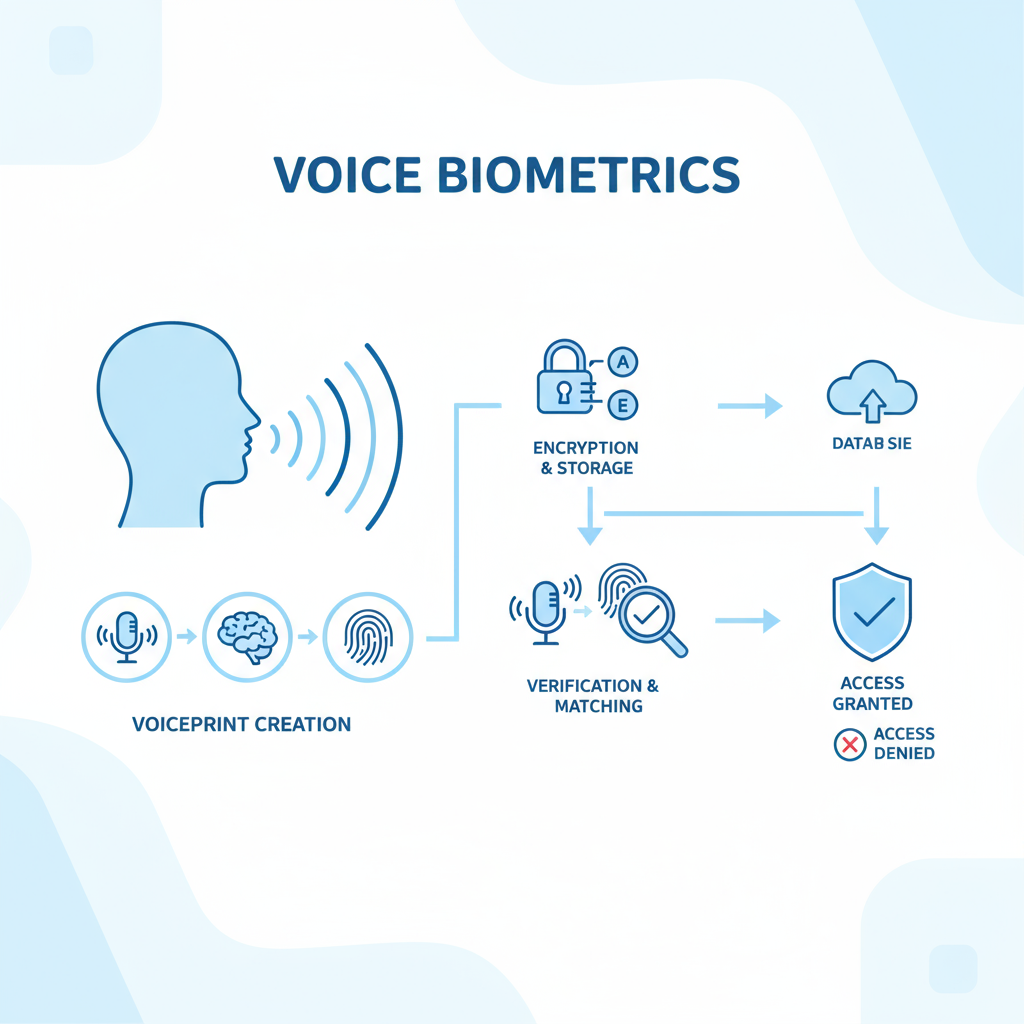
Voice authentication (also called speaker recognition) is a biometric process that identifies or verifies a person based on their unique voice patterns.
Every individual’s voice has distinctive acoustic features influenced by the shape of their vocal tract, mouth, nasal cavity, and even behavioral traits like accent, pitch, and tone. These characteristics form a voiceprint, similar to how fingerprints or iris scans represent physical identifiers.
When you enroll in a voice authentication system, your speech sample is recorded and analyzed to create a digital model — your “voice identity.” Later, when you attempt to log in or perform an action, the system compares your live voice sample against the stored voiceprint to verify authenticity.
Voice Recognition vs Speech Recognition
A common misconception is that voice recognition and speech recognition are the same. They are related but serve different purposes:
- Speech recognition focuses on what you say — converting spoken words into text or commands (like Siri or Alexa).
- Voice recognition, on the other hand, focuses on who is speaking — analyzing vocal patterns to confirm identity.
In other words, speech recognition understands content, while voice authentication software verifies the speaker.
Approaches to Voice Authentication
There are two primary types of voice authentication methods:
A. Text-Dependent Voice Authentication
In text-dependent systems, users must say a specific phrase or passcode during enrollment and authentication.
Examples:
- Static phrases like “My voice is my password.”
- Dynamic phrases, where a system generates random words or numbers each time (for higher security).
Pros:
- High accuracy and easy to implement.
- Suitable for secure environments like banking and contact centers.
Cons:
- Limited flexibility — the user must remember or repeat specific phrases.
B. Text-Independent Voice Authentication
In text-independent systems, users can say anything — the system identifies them based on voice patterns alone.
Pros:
- More flexible and user-friendly.
- Works well in natural conversation (like customer service calls).
Cons:
- Requires more sophisticated algorithms and may have slightly lower accuracy than text-dependent systems in noisy environments.
Both approaches have value, and modern voice authentication software often combines them for stronger, context-aware security.
How Voice Authentication Works: A Detailed Explanation
Voice authentication has become one of the most practical forms of biometric security, used everywhere from banking call centers to smart home devices. Unlike passwords or PINs, which can be forgotten, shared, or stolen, a person’s voice carries unique physical and behavioral signatures that are extremely difficult to replicate. Below is a detailed breakdown of the technology and process behind this system.
1. Enrollment: Building the Voiceprint
Enrollment is the foundational step of voice authentication, and its quality directly determines how accurate and secure the entire system will be later on.
Capturing the Voice Sample
When a user enrolls, the system asks them to speak — either a fixed passphrase (like “My voice is my password”) or a few sentences of natural speech, depending on whether the system is text-dependent or text-independent. This is usually done multiple times, and sometimes in different conditions (quiet room, with background noise, different moods or energy levels), so the system captures a more robust picture of how the voice varies naturally rather than a single narrow snapshot.
Feature Extraction
Once the audio is captured, the software doesn’t store the raw recording. Instead, it runs signal processing algorithms to strip out irrelevant noise and extract meaningful acoustic characteristics, including:
- Pitch (fundamental frequency) — the perceived highness or lowness of the voice, influenced by vocal cord vibration speed
- Tone and timbre — the quality that makes a voice sound “warm,” “nasal,” “breathy,” etc., shaped by how sound resonates through the vocal tract
- Rhythm and cadence — the natural pacing, pauses, and stress patterns a person uses while speaking
- Pronunciation and articulation — how specific phonemes (sound units) are formed, often influenced by accent, dialect, or speech habits
These features are typically converted into a numerical representation — often called a feature vector or, in modern systems, an embedding generated by a neural network trained specifically to distinguish speakers.
Creating the Voiceprint (Template)
The extracted features are compiled into a mathematical model — the voiceprint — which acts as a compact, unique digital fingerprint of the person’s vocal identity. This is not audio that can be played back; it’s an abstract numerical representation, similar to how a fingerprint scanner stores ridge patterns rather than a photo of your finger.
Secure Storage
The voiceprint is then encrypted and stored, usually with strong cryptographic protection (such as AES encryption) and sometimes using techniques like biometric template protection or cancelable biometrics, which allow the template to be revoked and reissued if compromised — something a raw biometric trait like a fingerprint or voice can’t naturally do.
2. Verification: Confirming Identity in Real Time
Verification is the moment-to-moment process that happens every time a user tries to authenticate after enrollment.
Live Voice Capture
The system records a fresh voice sample at the point of authentication — this could be the user speaking a passphrase, answering a prompted question, or simply talking naturally during a call (in continuous/passive authentication systems).
Preprocessing
Before comparison, the new sample undergoes cleanup: background noise reduction, silence trimming, and normalization for volume and recording quality. This ensures that environmental factors don’t unfairly skew the comparison.
Feature Comparison
The system extracts the same type of features used during enrollment and compares this new “live” voiceprint against the stored template using mathematical similarity measures — often cosine similarity, Euclidean distance, or more advanced scoring functions in deep-learning-based systems (such as those using x-vectors or d-vectors).
Threshold-Based Decision
The comparison produces a similarity score, usually between 0 and 1 (or expressed as a percentage). This score is measured against a predefined threshold:
- If the score meets or exceeds the threshold, the system confirms a match and grants access.
- If it falls below the threshold, access is denied.
The threshold itself is a critical design choice — set it too low, and impostors may slip through (a false acceptance); set it too high, and legitimate users may get locked out (a false rejection). Systems often allow this threshold to be tuned based on the security level required (e.g., a banking app may demand a stricter match than a voice assistant).
3. Matching: The Science Behind the Comparison
The matching process is what makes voice authentication genuinely difficult to spoof, because it evaluates two fundamentally different categories of traits simultaneously.
Physiological Traits
These are rooted in a person’s actual physical anatomy and are largely unchangeable:
- Vocal cord structure — the size, length, and tension of the vocal folds affect pitch and vibration patterns
- Resonance chambers — the shape and size of the throat, nasal cavity, and mouth influence how sound waves resonate and are “colored” before leaving the body
- Vocal tract length — even subtle differences in the length of a person’s vocal tract create measurable differences in formant frequencies (the resonant frequencies that shape vowel sounds)
Because these are physical attributes, they’re extremely hard for an impostor to fake — even a skilled voice mimic can’t fully replicate someone else’s vocal tract anatomy.
Behavioral Traits
These are learned patterns shaped by a person’s habits, environment, and personality:
- Speaking style — pacing, pauses, and emphasis unique to how someone naturally communicates
- Accent and dialect — regional or cultural influences on pronunciation
- Intonation patterns — the rise and fall of pitch across a sentence, which often reflects emotional tone or emphasis habits
Why Combining Both Makes It Robust
By analyzing physiological and behavioral traits together, voice authentication systems create a layered defense. An attacker might be able to mimic someone’s accent or speaking rhythm (behavioral), but replicating their exact vocal tract resonance (physiological) is far harder — and vice versa. This dual-layer approach is also why modern systems increasingly use liveness detection and anti-spoofing algorithms to catch recorded playback or AI-generated deepfake voices, since synthetic audio often lacks the full complexity of a real, live vocal apparatus.
Voice Liveness Detection, Security, and Real-World Applications: An In-Depth Look
Building on the fundamentals of how voice authentication works, this section dives deeper into the safeguards, risks, regulations, and practical applications that shape how voice biometrics are used responsibly in the real world.
What Is Voice Liveness Detection?
Liveness detection, also called Presentation Attack Detection (PAD), is one of the most critical safeguards in modern voice biometric systems. Its core purpose is simple but essential: to confirm that the voice being analyzed is coming from a real, physically present human being at that exact moment — not from a recording played back through a speaker, not from a synthetic voice generated by AI, and not from any other form of impersonation attempt.
This matters enormously because voice authentication, unlike a password, is based on something inherently public. A person’s voice can be captured from a phone call, a YouTube video, a voicemail, or even a few seconds of casual conversation. Without liveness detection, a sufficiently good recording — or worse, an AI-cloned voice trained on just a few minutes of audio — could potentially fool a system that only checks for a voiceprint match.
How Liveness Detection Works in Practice
Challenge-Response Mechanisms
One of the most common techniques is prompting the user to speak something unpredictable — a randomly generated sequence of numbers, a unique phrase, or a specific word that changes every time. This is important because it defeats simple replay attacks: if an attacker only has a recording of the user saying “my voice is my password,” that recording becomes useless when the system instead asks them to say “seven, two, nine, four.” The randomness forces the response to be generated live, in real time.
Real-Time Acoustic Analysis
Beyond just the words spoken, liveness systems examine the micro-characteristics of the audio signal itself — things a recording or synthetic voice often fails to reproduce perfectly:
- Breath patterns — natural inhalation and exhalation sounds that occur around speech, which are difficult for synthetic voices to mimic convincingly
- Background acoustic texture — the subtle ambient sound consistent with a live microphone picking up a real environment, as opposed to the flatter, more artificial acoustic signature of a replayed recording
- Micro-inconsistencies in natural speech — tiny variations in pitch, pacing, and articulation that occur naturally when a person speaks spontaneously, which are often subtly “too perfect” or repetitive in recordings and AI-generated audio
AI-Driven Authenticity Detection
Modern liveness detection increasingly relies on deep learning models trained specifically to distinguish authentic human speech from spoofed audio. These models are trained on massive datasets containing both genuine recordings and various types of attacks (replay attacks, voice conversion, text-to-speech synthesis, and deepfakes), allowing them to pick up on subtle statistical artifacts that spoofed audio tends to leave behind — artifacts that are often imperceptible to the human ear but detectable through spectral analysis.
Together, these layers make liveness detection a crucial line of defense as deepfake technology becomes more accessible and convincing.
Accuracy and Environmental Challenges
No biometric system is perfect, and voice authentication is no exception. Understanding how accuracy is measured — and what factors can disrupt it — is essential for anyone evaluating or deploying this technology.
Core Accuracy Metrics
- False Acceptance Rate (FAR): This measures how often the system mistakenly grants access to someone who isn’t the enrolled user. A high FAR is dangerous in security-sensitive contexts, since it means impostors are getting through.
- False Rejection Rate (FRR): This measures the opposite problem — how often the system incorrectly denies access to the legitimate, enrolled user. A high FRR frustrates real users and undermines the usability of the system.
- Equal Error Rate (EER): This is the point at which FAR and FRR are equal, and it’s widely used as a single summary metric of a system’s overall accuracy. The lower the EER, the better the biometric system is at distinguishing genuine users from impostors across a range of threshold settings.
These metrics matter because every voice authentication deployment has to make a trade-off. A bank might tolerate a slightly higher FRR (occasionally asking legitimate customers to re-verify) in exchange for a very low FAR (minimizing fraud risk), while a consumer smart speaker might prioritize convenience and accept a slightly higher FAR in exchange for smoother user experience.
Environmental Factors That Undermine Accuracy
Voice is a uniquely fragile biometric compared to something like a fingerprint, because it’s constantly influenced by external and internal conditions:
- Background noise and microphone quality — a cheap or damaged microphone, or a noisy environment like a busy street or crowded office, can distort the captured audio enough to reduce matching accuracy
- Illness, stress, or aging — a cold, sore throat, or even emotional stress can measurably change vocal characteristics like pitch and clarity; over the long term, aging naturally alters vocal cord elasticity and resonance
- Environmental acoustics and echo — recording in a room with hard surfaces, poor acoustic dampening, or significant echo can distort the acoustic signal being analyzed
Adaptive Systems
To counter these challenges, modern voice authentication platforms increasingly rely on continuous learning. Rather than relying on a single static enrollment, some systems update the stored voiceprint incrementally over time as they collect more verified samples, allowing them to adapt naturally to gradual voice changes (like aging) while remaining sensitive enough to flag sudden, suspicious shifts.
Security Risks and Limitations
Despite its convenience, voice authentication comes with a distinct set of vulnerabilities that organizations must actively manage.
1. Spoofing Risks
Even with liveness detection, spoofing remains an evolving threat. Attackers have several avenues of attack:
- Replay attacks — playing a recording of the legitimate user’s voice
- Voice conversion — digitally altering one person’s voice to sound like another
- Text-to-speech synthesis — using AI to generate entirely new speech in a target’s voice from text input
- Deepfake voice cloning — increasingly sophisticated AI models that can replicate a person’s voice from just a few seconds of sample audio, sometimes convincingly enough to fool both humans and imperfect detection systems
Without robust, continuously updated liveness detection, these attacks can succeed — which is why leading providers treat anti-spoofing as an ongoing arms race rather than a one-time solved problem.
2. Data Breaches
Perhaps the most serious long-term risk with any biometric system is what happens if the stored data is stolen. Unlike a password, which can simply be reset, a person’s voice is permanent — you cannot issue yourself a new one. If a database of voiceprints is breached, those users face a lifelong exposure risk, since the same voiceprint (or the same physical voice) may be tied to other systems as well. This is why strong encryption, secure storage architecture, and — where possible — local (on-device) storage rather than centralized cloud storage are considered best practices.
3. Accuracy Variations
As discussed above, temporary or permanent changes in a person’s voice — from illness, fatigue, stress, or simply aging — can degrade system performance. This isn’t just an inconvenience; in high-security contexts, a system that fails legitimate users too often will push them toward less secure fallback methods (like static PINs), potentially undermining the whole point of using biometrics.
4. Privacy Concerns
Because voice is both a biometric identifier and a rich source of personal information (potentially revealing emotional state, health conditions, accent, or even approximate location through dialect), users need clear, transparent information about what data is collected, how long it’s retained, who can access it, and how it’s protected.
Mitigation Through Multi-Factor Authentication (MFA)
Given these risks, most security-conscious organizations don’t rely on voice authentication alone. Instead, they layer it with additional factors — such as a PIN, a one-time password (OTP) sent to a registered device, or a hardware token — so that even if one factor is compromised, an attacker still can’t gain access without the others.
Privacy, Compliance, and Ethical Considerations
Because voiceprints are a form of sensitive biometric data, their collection and use is subject to increasingly strict legal frameworks around the world.
Key Regulatory Frameworks
- GDPR (General Data Protection Regulation) — the EU’s comprehensive data protection law treats biometric data as a “special category” requiring explicit, informed consent before collection, along with strict rules on storage, processing, and the user’s right to have their data deleted.
- BIPA (Biometric Information Privacy Act) — this U.S. state-level law (Illinois) is one of the strictest biometric privacy statutes in the country, requiring organizations to clearly disclose their biometric data practices, obtain written consent, and follow specific retention and destruction schedules.
Similar laws exist or are emerging in other jurisdictions, reflecting a broader global trend toward treating biometric data with the same — or greater — sensitivity as financial or health records.
Organizational Responsibilities
To operate responsibly and stay compliant, organizations deploying voice authentication should ensure:
- Voiceprints are encrypted and non-reversible — meaning even if the stored template were somehow accessed, it couldn’t be used to reconstruct the original voice or be reverse-engineered into usable audio
- Explicit user consent — users should clearly understand and affirmatively agree to their voice being used for biometric authentication, rather than this being buried in fine print
- Defined data retention and deletion policies — voiceprints should not be kept indefinitely; they should be deleted once they’re no longer needed for their stated purpose (such as after account closure)
This “privacy by design” philosophy means privacy protections aren’t bolted on after the fact — they’re built into the system’s architecture from the very first stage of development.
Key Use Cases of Voice Authentication Software
Voice biometrics has moved well beyond niche applications and is now embedded across numerous industries.
1. Banking & Financial Services
Financial institutions were early and enthusiastic adopters of voice biometrics, using it to verify customer identity during phone banking, mobile app logins, and fraud investigations. Instead of asking customers to recall answers to security questions (which can often be found or guessed by attackers using social engineering), banks can simply have the customer speak a passphrase, drastically reducing both fraud risk and customer friction.
2. Contact Centers
Traditional call center security — asking customers for their mother’s maiden name, account number, or a series of security questions — is slow and often frustrating. Voice authentication allows contact centers to verify a caller’s identity within seconds of them speaking, often passively in the background while the conversation is already underway, significantly reducing average handling time and improving overall customer satisfaction.
3. Smart Devices & IoT
From smart speakers to connected cars, voice recognition allows for secure, hands-free interaction. This is particularly valuable in contexts where touching a device isn’t practical or safe — for instance, unlocking a smart home system while carrying groceries, or verifying identity while driving.
4. Workforce Authentication
In corporate and industrial settings, voice authentication offers a touchless way for employees to log into systems, clock in and out, or access secure areas. This has proven especially valuable in environments where hygiene is a priority (such as food processing or healthcare facilities) or where employees frequently have their hands occupied.
5. Healthcare
Medical professionals often need fast, secure access to sensitive patient records, frequently while their hands are occupied with patient care. Voice verification allows staff to authenticate quickly without breaking workflow, while still maintaining strict access controls required by healthcare privacy regulations.
Advantages of Voice Authentication Software
- Contactless and Hygienic — a meaningful advantage in a post-pandemic world where touchless interactions are increasingly preferred
- High Accessibility — since virtually every smartphone, laptop, and many everyday devices already have a microphone, there’s no need for specialized hardware like fingerprint scanners or retina cameras
- User Convenience — eliminates the burden of remembering complex passwords or carrying physical access cards
- Cost-Effective — often easier and cheaper to integrate into existing systems compared to deploying new biometric hardware
- Scalable — works consistently across mobile apps, Interactive Voice Response (IVR) phone systems, and large enterprise platforms alike
Disadvantages and Challenges
- Environmental limitations — performs poorly in noisy environments and may be difficult or unreliable for users with certain speech impairments or conditions
- Voice consistency requirements — accuracy depends on relatively consistent voice quality over time, which can be disrupted by illness or other temporary changes
- Anti-spoofing dependency — the system’s security is only as strong as its underlying anti-spoofing and liveness detection algorithms, which must be continuously updated to keep pace with evolving attack techniques
- Privacy concerns — ongoing questions around data collection, consent, and long-term storage require careful, transparent handling
Addressing These Limitations
Many of these challenges can be mitigated through multi-modal biometrics — combining voice authentication with other biometric factors such as facial recognition or fingerprint scanning. This layered approach means that even if one modality is compromised or unreliable in a given situation (say, voice recognition struggling in a noisy environment), the system can fall back on or cross-verify with another method, providing both higher assurance and greater resilience.
Implementation and Best Practices
For a successful voice authentication deployment, organizations should follow these steps:
- Define Use Case: Identify where voice biometrics fits — customer login, employee access, or call center authentication.
- Choose Authentication Mode: Text-dependent for high security or text-independent for convenience.
- Integrate Liveness Detection: Essential for preventing spoofing and replay attacks.
- Ensure Privacy Compliance: Follow GDPR, BIPA, and regional laws.
- Provide Fallback Options: Offer PIN or OTP for users unable to authenticate via voice.
- Regularly Update Algorithms: Keep up with emerging deepfake and spoofing technologies.
Pro tip: Always combine biometrics with other authentication factors for optimal protection.
The Future of Voice Authentication in Cybersecurity
Voice authentication is evolving rapidly alongside artificial intelligence and machine learning.
Also Read:How Biometrics Enhance Multifactor Authentication
Emerging Trends:
- AI-powered adaptive models: Continuously learn from subtle changes in a user’s voice.
- Multimodal authentication: Combining voice, face, and behavioral biometrics for higher accuracy.
- Integration with IoT: Voice-based access for smart homes, vehicles, and wearables.
- Deepfake detection: New algorithms can detect synthesized or cloned voices with high precision.
- Passwordless systems: Replacing passwords entirely with biometrics for seamless, secure login.
In the coming years, voice biometrics will not just complement other security systems — it will redefine the future of digital identity verification.
Conclusion
Voice authentication software represents a major step forward in the evolution of biometric security. It offers an ideal blend of convenience, cost-efficiency, and contactless verification — making it perfect for modern digital systems.
However, as with all biometrics, it’s not entirely foolproof. To ensure maximum protection, voice authentication should be used alongside liveness detection and multi-factor authentication strategies.
Frequently Asked Questions
What is voice authentication software?
Voice authentication software uses biometric technology to verify a user’s identity based on their unique voice characteristics, such as pitch, tone, and pronunciation patterns.
How secure is voice recognition?
When combined with liveness detection and encryption, voice recognition is highly secure. It’s harder to spoof than passwords, though not entirely immune to deepfakes.
What’s the difference between text-dependent and text-independent voice authentication?
Text-dependent systems require a specific phrase, while text-independent systems can verify identity from any spoken words.
Can environmental noise affect voice authentication?
Yes. Background noise can reduce accuracy, so high-quality microphones and noise-canceling algorithms are essential.
Is voice data stored on servers?
It depends on implementation. For higher privacy, many systems store voiceprints locally on the device instead of cloud servers.
Can I use voice biometrics as part of MFA?
Absolutely. Voice can be one factor in multi-factor authentication, combined with passwords, devices, or tokens for enhanced security.
What happens if my voice changes due to illness?
Most advanced systems allow for re-enrollment or adapt to minor voice variations caused by illness or aging.
Is voice authentication suitable for businesses?
Yes. It’s widely used in banking, telecom, customer service, and workforce management due to its speed, convenience, and security.

Debabrata Behera is a passionate blogger who writes about digital trends, personal growth, and practical insights, helping readers stay informed, inspired, and ready to achieve success in life.