Facial emotion recognition is a technology that analyzes human facial expressions to identify emotional states. Humans naturally read emotions from faces during conversations, and this same idea is now applied using computers and artificial intelligence. As digital systems interact more closely with people, understanding emotions helps improve communication, decision-making, and user experience.
This technology is increasingly used in healthcare, education, customer service, and security to better understand human responses. By studying facial movements and expressions, machines attempt to recognize emotions such as happiness, sadness, anger, or surprise in a structured and measurable way.
What Is Facial Emotion Recognition?

Facial emotion recognition is the process of detecting and identifying human emotions based on facial expressions using computer-based systems. It combines image processing and artificial intelligence to interpret visual facial data.
- It analyzes facial features like eyes, eyebrows, mouth, and overall facial structure
- It converts facial movements into measurable data points
- It maps these data points to predefined emotional categories
Unlike humans, machines do not “feel” emotions. Instead, they identify patterns that statistically match known emotional expressions.
How Humans Express Emotions Through Facial Expressions
Human emotions are closely connected to facial muscle movements. When a person experiences an emotion, specific muscles contract or relax, creating visible expressions. These expressions often occur naturally and sometimes without conscious control.
- Facial muscles work together to form expressions
- Certain expressions appear consistently across people
- Facial expressions can change quickly based on emotional state
Because many expressions are biologically driven, they provide reliable visual signals that technology can analyze.
Core Emotions Detected by Facial Emotion Recognition Systems

Facial emotion recognition systems typically focus on a set of commonly accepted basic emotions. These emotions are identified based on recurring facial patterns.
- Happiness – Raised cheeks and smiling mouth
- Sadness – Drooping eyelids and downturned lips
- Anger – Lowered brows and tightened lips
- Fear – Wide eyes and raised eyebrows
- Surprise – Open mouth and lifted brows
- Disgust – Nose wrinkling and raised upper lip
- Neutral – Minimal facial movement
These categories help systems classify emotions consistently across different faces.
How Facial Emotion Recognition Technology Works
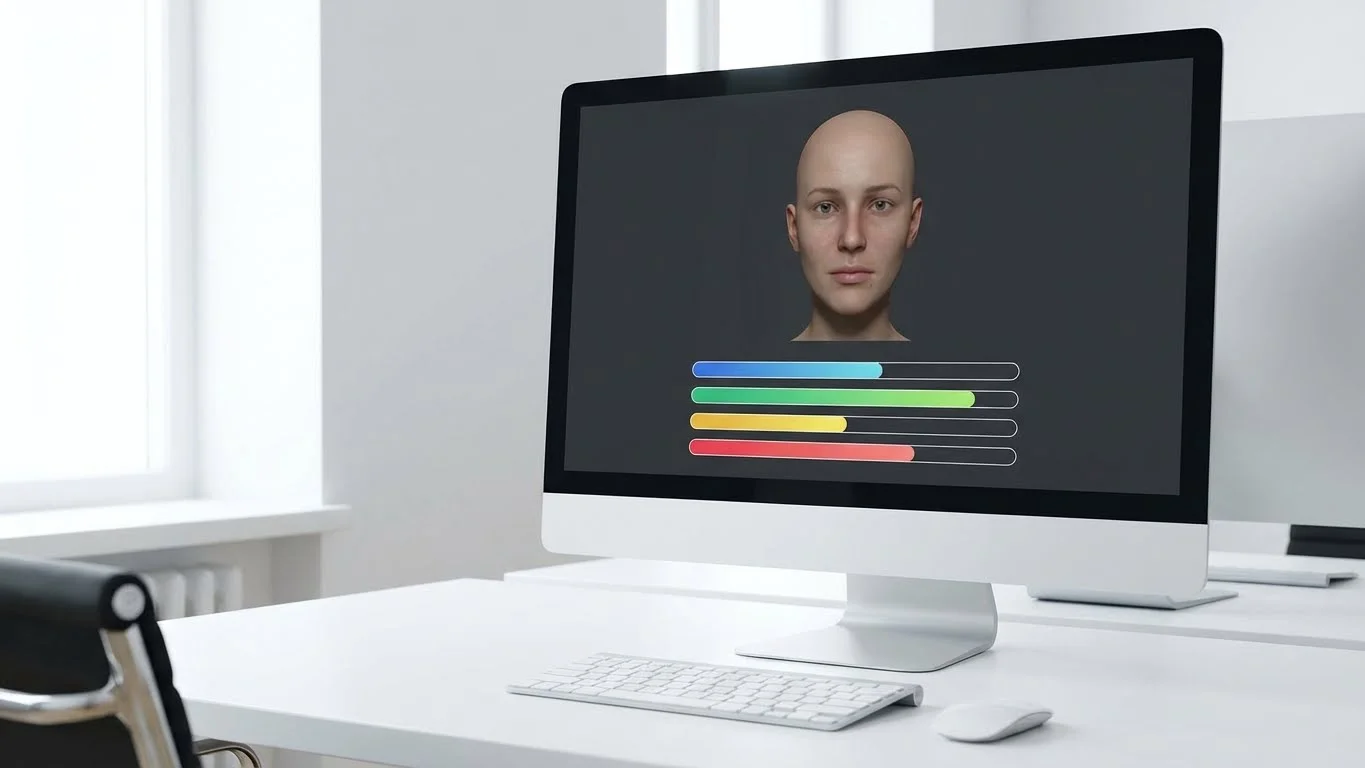
Facial emotion recognition follows a structured process that converts facial images into emotional predictions.
1. Face Detection
Face detection is the first step, where the system identifies the presence and location of a face within an image or video frame.
- Detects facial boundaries
- Separates the face from background elements
- Ensures the correct subject is analyzed
Without accurate face detection, emotion analysis cannot proceed.
2. Facial Landmark Detection
Once a face is detected, the system identifies specific key points on the face called landmarks.
- Tracks positions of eyes, eyebrows, nose, lips, and jaw
- Measures distances and angles between landmarks
- Observes how these points move over time
Landmarks provide a structured map of facial movement.
3. Feature Extraction
Feature extraction converts facial landmarks and textures into numerical data.
- Measures muscle movement intensity
- Analyzes shape changes and symmetry
- Captures subtle expression details
These features represent the facial expression in a form that algorithms can process.
4. Emotion Classification
In the final step, extracted features are compared against learned emotional patterns.
- Matches facial data with known emotion models
- Assigns probabilities to different emotions
- Selects the most likely emotional state
This step produces the final emotion output.
Role of Artificial Intelligence and Machine Learning
Artificial intelligence enables facial emotion recognition systems to learn from large amounts of facial data. Machine learning models improve by identifying patterns across many examples.
- Models are trained using labeled facial images
- Learning improves with diverse data
- Systems adapt to variations in expressions
AI allows these systems to move beyond simple rules and handle real-world complexity.
Technologies Used in Facial Emotion Recognition

Multiple technologies work together to support accurate emotion detection.
- Computer vision for image interpretation
- Deep learning models for pattern recognition
- Cameras and sensors for capturing facial data
Each technology contributes to processing, analysis, and classification accuracy.
Accuracy and Limitations of Facial Emotion Recognition
While facial emotion recognition is effective, it is not perfect. Accuracy depends on several conditions and constraints.
- Lighting and camera quality affect detection
- Facial coverings or head angles can reduce accuracy
- Individual and cultural differences influence expressions
These limitations highlight the importance of careful interpretation and responsible use.
Privacy and Ethical Considerations
Emotion recognition involves sensitive personal data, making privacy and ethics critical concerns.
- Facial data must be protected securely
- User consent is essential
- Systems must avoid misuse and discrimination
Responsible deployment ensures trust and compliance with ethical standards.
Benefits of Facial Emotion Recognition Technology
When used correctly, facial emotion recognition offers meaningful advantages.
- Enhances human-computer interaction
- Provides emotional context for better decisions
- Enables personalized digital experiences
These benefits help organizations design more human-centered systems.
Challenges and Risks in Emotion Detection
Despite its benefits, emotion detection carries certain risks.
- Emotions may be misinterpreted
- Over-reliance on automated systems can be problematic
- Emotional data misuse can cause social harm
Addressing these challenges is necessary for safe and effective use.
Facial Emotion Recognition vs Other Emotion Detection Methods
Facial emotion recognition is one of several approaches to emotion analysis.
- Compared with voice-based emotion detection
- Compared with physiological signal analysis
- Facial analysis offers non-invasive observation
Each method has strengths and limitations, and they are often combined for better accuracy.
Conclusion
Facial emotion recognition detects human feelings by analyzing facial expressions through structured computational processes. By identifying facial features, extracting meaningful data, and classifying emotional patterns, technology attempts to understand human emotions in a measurable way. While powerful, this technology must be applied responsibly, with awareness of its limitations, ethical considerations, and impact on privacy. When used carefully, facial emotion recognition can enhance communication, improve user experiences, and support better decision-making across industries.