Facial recognition technology has become a part of everyday life, from unlocking smartphones like Apple’s Face ID to enhancing security at airports. This technology analyzes unique facial features to identify or verify individuals, revolutionizing security, convenience, and personalization across multiple domains. Understanding how it works is essential as it impacts privacy, security, and technology adoption worldwide. This guide will provide a detailed explanation of facial recognition technology, covering its processes, types, algorithms, applications, benefits, challenges, and future trends.
Fundamentals of Facial Recognition Technology
Facial recognition is a type of biometric technology that identifies individuals by analyzing distinct features of their faces. Unlike other biometric systems like fingerprint or iris scans, facial recognition is non-intrusive and can function at a distance without physical contact. At its core, it involves capturing facial data—often called “faceprints”—which are then compared against a stored database for identification or verification. Artificial intelligence (AI) and machine learning significantly enhance the accuracy and efficiency of this technology by enabling systems to learn and improve over time.
Key terms related to facial recognition include biometric data, faceprint (the unique numerical representation of a face), and facial templates (face maps used for matching).
The Four-Step Facial Recognition Process
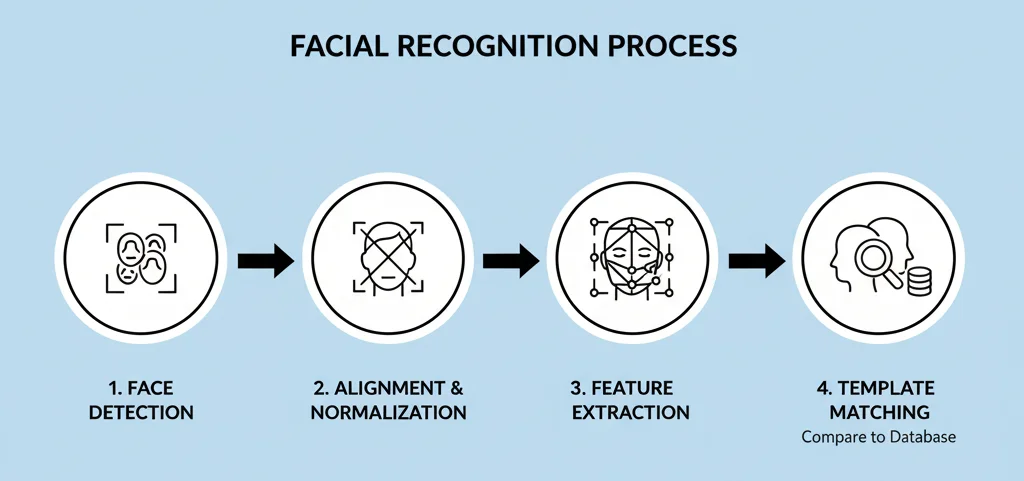
Step 1: Face Detection
Face detection is the initial step where the system locates human faces within images or videos. Advanced algorithms such as the Viola-Jones method, Histogram of Oriented Gradients (HOG), Support Vector Machines (SVM), and Convolutional Neural Networks (CNNs) are commonly used. These algorithms identify key facial features and demarcate the face from the background. Challenges in this step include varying lighting conditions, occlusions (e.g., masks or hats), and different facial orientations.
Step 2: Face Normalization & Feature Extraction
Once detected, the face undergoes normalization, which standardizes the size, orientation, and lighting to ensure consistent comparisons. The system then extracts critical facial landmarks like eyes, nose, mouth, and jawline. Techniques such as Principal Component Analysis (PCA), Local Binary Patterns (LBP), Eigenfaces, and Linear Discriminant Analysis (LDA) are used to capture and convert these features into a detailed facial template.
Step 3: Template Generation
Facial features are transformed into numerical representations called faceprints or embeddings. These encode the unique characteristics of a face in vector form, making them suitable for efficient storage and comparison. Maintaining these templates securely is crucial for data privacy and system integrity.
Step 4: Matching & Identification
The final phase involves comparing the faceprint against one or more stored templates in a database. Systems perform verification (1:1 match) or identification (1:N match) using similarity scores derived from algorithms like cosine or Euclidean distance metrics. Decision thresholds determine whether a match is accepted or rejected.
Types of Facial Recognition Technology
2D Facial Recognition
This technology uses standard digital images taken by cameras in devices such as smartphones or biometric terminals. It relies on analyzing nodal points and their relative distances on a flat image. While it is cost-effective and widely used, it is susceptible to changes in lighting, facial expressions, and angles.
3D Facial Recognition
Utilizing stereoscopic images or multiple 2D images to create depth maps, 3D facial recognition captures the contours and shapes of a face. This method overcomes many limitations of 2D systems, providing higher accuracy and robustness, especially against lighting variations and pose changes. Apple’s Face ID employs this technology using infrared sensors and a dot projector. Its downside is higher cost, though innovations continue to reduce expenses.
Facial Recognition at a Distance
This advanced approach enables identification of individuals from several meters away using high-resolution cameras combined with AI-powered algorithms. It is often integrated with CCTV for real-time public space monitoring, enhancing security without requiring close interaction.
Thermal Imaging Facial Recognition
Thermal cameras capture heat signatures emitted by the face, enabling recognition in low-light or no-light environments where standard cameras may fail. This technology detects unique thermal patterns and is less affected by facial coverings, making it valuable for security and healthcare applications.
Also Read: What is Cloud Security? Definition, Importance, and How to Protect Your Data
Key Algorithms and Technologies
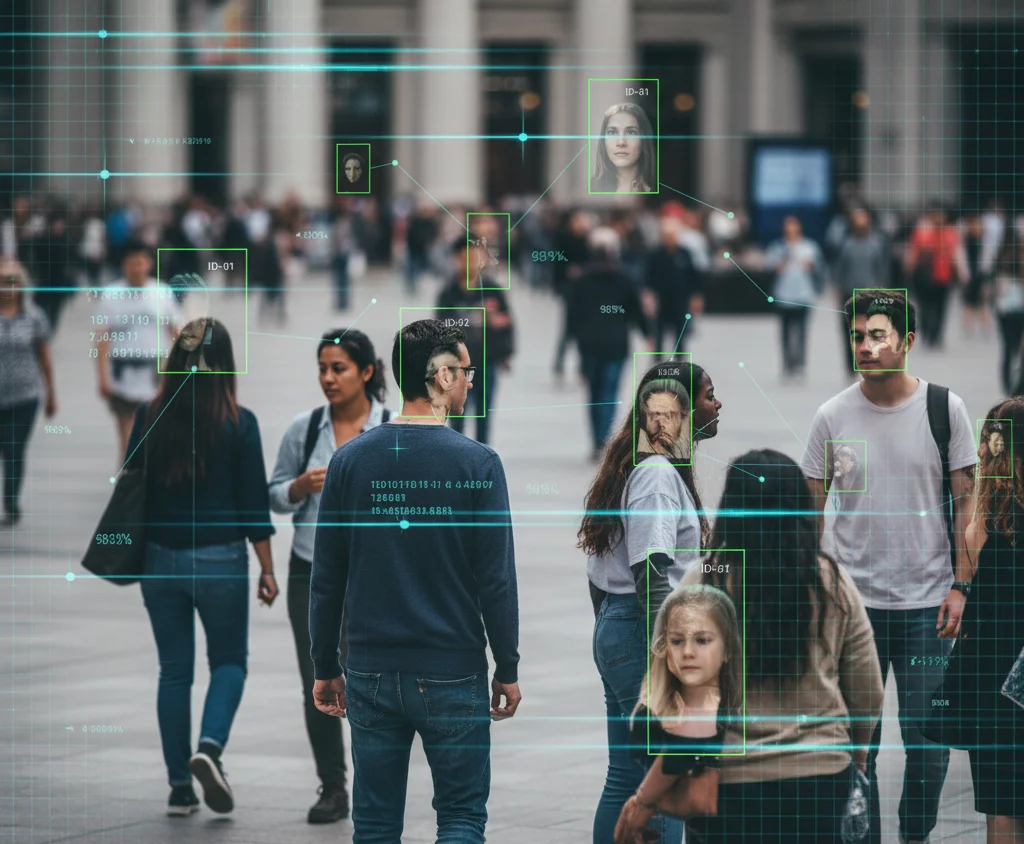
Several algorithms underpin facial recognition technology:
- Viola-Jones Algorithm: Rapid face detection using Haar cascades.
- Histogram of Oriented Gradients (HOG): Detects object shapes and features effectively.
- PCA and Eigenfaces: Reduce dimensionality of face data to extract features.
- LDA: Maximizes class separability in facial features.
- Deep Learning and CNNs: Automatically learn complex face features for improved accuracy.
- Triplet Loss, FaceNet, ArcFace: Advanced models that enhance embedding learning and matching precision.
These algorithms vary in complexity and effectiveness, often incorporated into hybrid systems.
Facial Liveness Detection & Anti-Spoofing
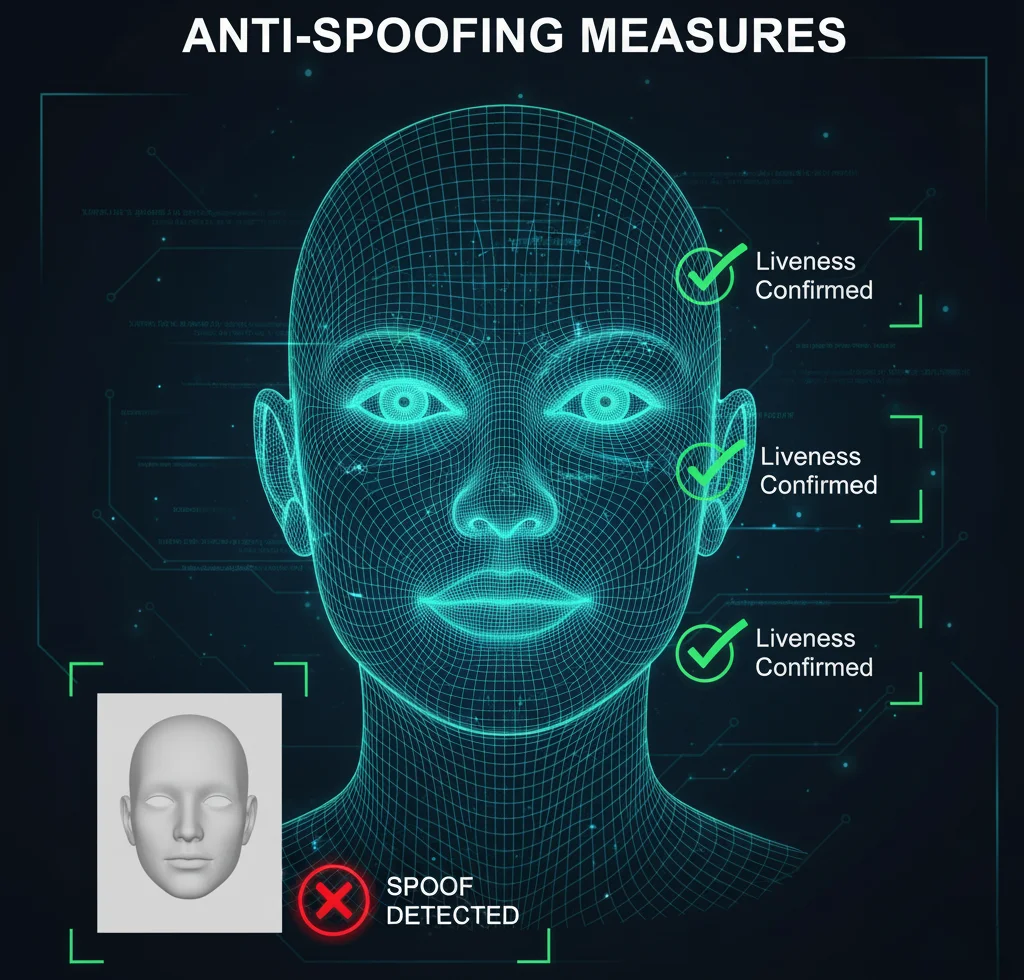
Liveness detection ensures that the face presented is of a live person, not a photo, video, or mask. Techniques analyze facial movements such as eye blinking, head tilting, and expressions. These prevent spoofing attacks, securing systems against fraudulent access. Implementing liveness detection is critical for maintaining trust and security in biometric applications.
Real-World Applications & Use Cases
Facial recognition technology has wide applications:
- Security & Law Enforcement: Identifying suspects, border security, and crime prevention.
- Consumer Electronics: Smartphone unlocking, payment authentication, and app security.
- Physical Access Control: Secure building entry, attendance management.
- Retail & E-Commerce: Personalized marketing, VIP identification, theft prevention.
- Healthcare: Patient verification, contactless identification, record accuracy.
- Banking & Finance: ATM security, fraud detection, online banking.
- Transportation & Travel: Automated check-in, boarding passes, driver verification.
- Education: Attendance automation, campus security.
- Social Media & Entertainment: Photo tagging, personalized content.
Benefits of Facial Recognition Technology
This technology enhances security, provides contactless authentication, and speeds up identification processes. It can recognize faces even with masks and analyze facial emotions for personalized experiences. Its scalability and integration with AI allow for continuous improvement and real-time threat detection.
Challenges & Limitations
Despite advantages, facial recognition faces challenges including privacy concerns, data security, algorithmic biases against certain demographics, environmental sensitivities, and regulatory hurdles. Accuracy can vary with lighting, facial expressions, and occlusions, requiring constant refinement.
Privacy, Security, and Ethical Considerations
Privacy laws such as GDPR and CCPA emphasize the need for responsible biometric data handling. Ethical deployment involves secured data storage with encryption, explicit consent, and transparent policies to prevent misuse or unauthorized surveillance. Balancing innovation and individual rights remains a critical challenge.
How to Choose a Facial Recognition System
When selecting a system, consider accuracy, speed, environmental compatibility, integration flexibility, vendor credibility, cost, and support. Evaluate based on intended application, scalability, and compliance with privacy regulations.
Future Trends & Innovations
Advances in AI, machine learning, and sensor technology promise more accurate, faster, and affordable systems. Multi-modal biometrics and integrated authentication platforms are emerging. Regulatory frameworks are evolving to address privacy concerns while facilitating innovation.
Conclusion
Facial recognition technology is transforming how we interact with security and identification systems. Its benefits in security, convenience, and personalization are balanced by challenges that require ethical considerations and robust protections. Understanding how it works enables informed decisions for businesses and individuals.
FAQs
1. What is facial recognition technology used for?
Facial recognition is used in security, mobile device authentication, retail, healthcare, and more.
2. How accurate is facial recognition?
Accuracy varies with technology type, environment, and algorithms but has improved significantly with AI.
3. Is facial recognition secure?
When combined with liveness detection and encryption, it offers high security.
4. What are privacy concerns with facial recognition?
These include unauthorized tracking, data breaches, and misuse without consent.
5. How does 3D facial recognition differ from 2D?
3D captures depth and contours, providing better accuracy and robustness.
6. Can facial recognition work with masks?
Advanced systems with mask recognition and thermal imaging can identify masked individuals.
7. What industries use facial recognition?
Security, finance, retail, healthcare, education, transportation, and social media.