The healthcare and pharmaceutical sector is one of the most complex industries when it comes to marketing strategies. Unlike other industries, marketing in pharma involves strict regulations, scientific evidence, patient safety considerations, and multiple stakeholders such as physicians, healthcare providers, regulatory authorities, and patients.
To make informed decisions about promotional spending and marketing strategies, pharmaceutical companies increasingly rely on Marketing Mix Modelling (MMM). This data-driven approach helps businesses analyze how different marketing activities impact sales performance, brand awareness, and product adoption.
In today’s highly competitive healthcare landscape, understanding the pharma marketing mix and applying advanced analytics can help companies optimize their marketing investments. This blog explores the evolution of marketing mix modelling in healthcare, insights from real-world evidence studies, how companies are adapting to market changes, and the future of marketing mix modelling in the pharmaceutical industry.
Marketing Mix Evolution Through Time
The concept of the marketing mix has evolved significantly over the decades. In the early days, marketing strategies relied mainly on traditional frameworks and basic sales data. However, the growing complexity of marketing in pharma industry has led to the adoption of advanced analytical models and data-driven approaches.
Early Development of Marketing Mix Models
Marketing mix modelling originally emerged as a statistical method to measure the effectiveness of various marketing activities. Companies began analyzing how different factors—such as advertising, promotions, pricing strategies, and distribution channels—affected product sales.
In the pharmaceutical sector, early marketing mix models were primarily focused on measuring the impact of physician visits, medical conferences, and traditional promotional materials. However, these models were often limited due to lack of detailed data and analytical capabilities.
With the advancement of data analytics, pharmaceutical companies now have access to more comprehensive data sources, enabling them to develop more accurate models.
Traditional 4Ps Framework in Healthcare Marketing
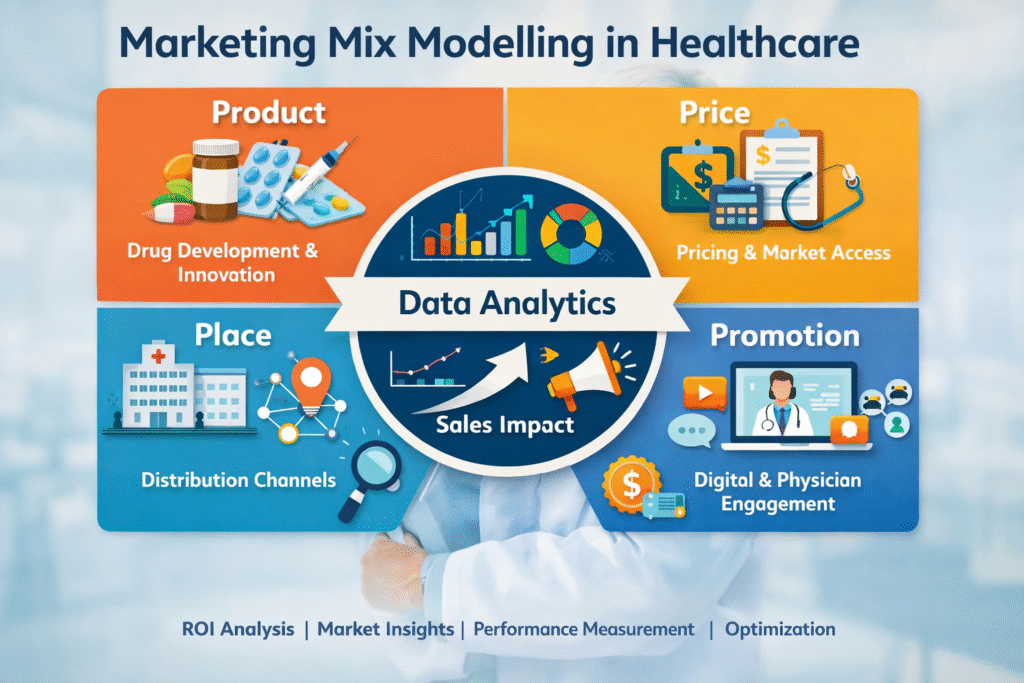
The classic marketing mix framework consists of four elements:
- Product
- Price
- Place
- Promotion
In marketing for pharmaceutical companies, these elements take on unique characteristics.
Product
Pharmaceutical products are not ordinary consumer goods. They require clinical trials, regulatory approvals, and strict quality standards. Marketing strategies must therefore emphasize scientific credibility and therapeutic benefits.
Price
Pricing strategies in the pharmaceutical sector are heavily influenced by regulatory policies, insurance systems, and reimbursement structures. Companies must balance profitability with accessibility and affordability.
Place
Distribution in the pharmaceutical industry involves hospitals, pharmacies, healthcare institutions, and medical distributors. Ensuring product availability across healthcare systems is a critical component of the marketing mix.
Promotion
Promotional strategies in pharma are very different from traditional marketing. Activities include:
- Physician detailing
- Medical conferences
- Educational programs
- Scientific publications
- Digital medical platforms
All promotional activities must comply with regulatory guidelines and ethical standards.
Shift from Basic Analytics to Data-Driven Decision Making
Over time, pharmaceutical companies began recognizing the limitations of intuition-based marketing decisions. As competition increased and healthcare costs grew, organizations needed more precise ways to evaluate marketing effectiveness.
This led to the development of marketing mix model for pharmaceutical industry, which uses statistical techniques to measure the impact of different marketing activities.
These models help companies answer questions such as:
- Which promotional channels drive the most prescriptions?
- How much should be invested in physician engagement programs?
- What is the optimal marketing budget allocation?
By analyzing historical data, marketing mix models can identify patterns and correlations between promotional activities and sales outcomes.
Integration of Digital Marketing Channels

The digital transformation of healthcare has dramatically changed marketing in pharma industry. Today, pharmaceutical companies use multiple digital channels such as:
- Online medical portals
- Virtual conferences
- Email campaigns
- Social media engagement
- Telemedicine platforms
Marketing mix modelling now includes digital engagement metrics, helping companies understand how online activities influence healthcare professionals and patients.
Importance of Analytics in Pharmaceutical Marketing
Advanced analytics has become essential for modern pharmaceutical marketing. With large volumes of data available, companies can analyze customer behavior, treatment patterns, and healthcare trends.
Data analytics enables companies to:
- Identify high-value target audiences
- Optimize promotional strategies
- Improve resource allocation
- Measure campaign performance
This shift toward data-driven decision-making has made pharma marketing mix analysis a crucial component of strategic planning.
Marketing Mix Insights from Real-World Evidence Study
Real-world evidence (RWE) has emerged as a powerful tool in healthcare analytics. It provides valuable insights into how drugs perform in real clinical settings outside controlled clinical trials.
In the context of marketing for pharmaceutical companies, real-world evidence can help evaluate the effectiveness of marketing strategies.
What is Real-World Evidence
Real-world evidence refers to data collected from sources such as:
- Electronic health records
- Insurance claims databases
- Patient registries
- Hospital records
- Wearable health devices
This data helps companies understand how treatments are used in everyday clinical practice.
Evaluating Marketing Performance
When combined with marketing mix model for pharmaceutical industry, real-world evidence can provide deeper insights into marketing effectiveness.
For example, companies can analyze:
- How physician education programs influence prescribing behavior
- Whether digital campaigns increase patient awareness
- How marketing activities affect treatment adoption rates
These insights allow marketers to refine their strategies and focus on high-impact activities.
Data Sources Used in Marketing Mix Studies
Several data sources are commonly used in healthcare marketing analytics:
- Prescription data
- Physician engagement metrics
- Sales data from pharmacies
- Patient treatment patterns
- Market access and reimbursement data
By integrating these data sources, pharmaceutical companies can build comprehensive marketing mix models.
Impact of Real-World Insights on Marketing Decisions
Real-world evidence enables pharmaceutical marketers to move beyond theoretical assumptions. Instead of relying on generalized strategies, companies can design campaigns based on real patient and physician behavior.
This helps organizations:
- Improve marketing efficiency
- Increase product adoption
- Enhance patient outcomes
- Reduce unnecessary marketing spending
Adapting Marketing Mix Analysis to Changing Pharma Market Landscape
The pharmaceutical industry is undergoing rapid transformation due to technological advancements, regulatory changes, and shifting patient expectations. As a result, marketing in pharma must continuously adapt.
Changing Healthcare Regulations
Healthcare marketing is heavily regulated to ensure patient safety and ethical practices. Regulations govern how pharmaceutical companies communicate with healthcare professionals and promote medications.
Marketing teams must ensure that all promotional activities comply with regulatory guidelines. This requires careful planning, documentation, and monitoring.
Rise of Digital Healthcare Marketing
Digital technologies have revolutionized marketing in pharma industry. Today, healthcare professionals rely on online resources for medical information.
Digital marketing strategies now include:
- Webinars and virtual medical conferences
- Online physician education platforms
- Digital medical journals
- Healthcare apps and patient portals
Marketing mix models must account for these digital channels when evaluating marketing effectiveness.
Increasing Role of Patient Engagement
Patient engagement has become a central focus of pharmaceutical marketing. Modern healthcare emphasizes patient-centered care, where patients actively participate in treatment decisions.
Pharmaceutical companies now invest in:
- Patient education campaigns
- Support programs
- Digital health tools
- Medication adherence initiatives
These activities influence treatment outcomes and must be incorporated into the pharma marketing mix.
Omnichannel Marketing Strategies
Healthcare professionals interact with pharmaceutical brands through multiple channels. Companies must ensure consistent messaging across these channels.
An omnichannel approach integrates:
- Field sales representatives
- Email communication
- Digital platforms
- Medical conferences
- Professional networks
Marketing mix models help companies determine which combination of channels produces the best results.
Importance of Advanced Analytics
Modern pharmaceutical marketing requires sophisticated analytics tools capable of handling large datasets and complex variables.
Advanced analytics enables marketers to:
- Predict prescription trends
- Identify emerging market opportunities
- Optimize promotional spending
- Improve campaign performance
The Future Consideration of Marketing Mix Modelling in Healthcare
The future of marketing in pharma will be driven by innovation, technology, and data intelligence. Marketing mix modelling will continue evolving to support more sophisticated decision-making.
Artificial Intelligence and Machine Learning
Artificial intelligence is transforming healthcare marketing analytics. Machine learning algorithms can analyze vast amounts of data and detect patterns that traditional models may miss.
AI-powered marketing mix models can:
- Predict physician prescribing behavior
- Forecast product demand
- Identify optimal marketing strategies
Predictive Analytics
Predictive analytics enables pharmaceutical companies to anticipate market changes and adjust their marketing strategies accordingly.
For example, companies can predict:
- Seasonal variations in drug demand
- Impact of new competitor launches
- Changes in treatment guidelines
This helps companies stay ahead in the competitive marketing in pharma industry.
Personalization in Pharmaceutical Marketing
Personalized marketing strategies are becoming increasingly important. Healthcare professionals expect tailored content that matches their specialties and interests.
Marketing mix models help companies determine the most effective personalized engagement strategies.
Real-Time Marketing Optimization
Traditional marketing strategies relied on periodic analysis. However, modern analytics platforms allow companies to monitor marketing performance in real time.
Real-time optimization enables pharmaceutical marketers to quickly adjust campaigns based on current data.
Integration of Multi-Source Healthcare Data
Future marketing mix models will integrate multiple data sources, including:
- Clinical data
- Market access data
- Digital engagement data
- Patient outcome data
This holistic approach will provide deeper insights into the effectiveness of marketing for pharmaceutical companies.
Conclusion
Marketing in the pharmaceutical industry is becoming increasingly data-driven and sophisticated. Traditional marketing strategies are no longer sufficient in a highly regulated and competitive healthcare environment.
By adopting marketing mix model for pharmaceutical industry, companies can better understand the impact of their marketing activities and optimize their promotional investments.
As healthcare continues to evolve, marketing mix modelling will play a critical role in shaping future strategies. The integration of artificial intelligence, real-world evidence, digital engagement data, and advanced analytics will enable pharmaceutical companies to make smarter marketing decisions.
Ultimately, a well-optimized pharma marketing mix helps organizations deliver valuable medical information to healthcare professionals, improve patient outcomes, and ensure sustainable business growth.
FAQs
What is marketing mix modelling in healthcare?
Marketing mix modelling is a data-driven analytical method used to evaluate how different marketing activities influence sales performance and prescription behavior in the healthcare and pharmaceutical industry.
Why is marketing mix modelling important for pharmaceutical companies?
It helps pharmaceutical companies measure the effectiveness of marketing campaigns, optimize promotional spending, and improve decision-making based on data insights.
What factors are included in a pharma marketing mix?
A typical pharma marketing mix includes product strategy, pricing policies, distribution channels, promotional activities, physician engagement programs, and digital marketing initiatives.
How does real-world evidence support marketing in pharma?
Real-world evidence provides insights into how drugs are used in everyday clinical practice. These insights help companies understand the effectiveness of their marketing strategies and improve their promotional activities.
What is the future of marketing in pharma industry?
The future of marketing in pharma industry will be shaped by artificial intelligence, predictive analytics, personalized marketing strategies, and advanced data integration across healthcare systems.

Debabrata Behera is a passionate blogger who writes about digital trends, personal growth, and practical insights, helping readers stay informed, inspired, and ready to achieve success in life.