In the digital age, where nearly every device is connected to the internet, protecting sensitive data and network systems has become a priority for individuals and organizations alike. One of the most essential tools in this protection is the firewall — a system designed to act as a digital barrier between trusted and untrusted networks. Understanding what is firewall in computer, how it works, and why it is vital can help users and businesses strengthen their cybersecurity measures effectively.
Firewall Meaning and Definition

To begin, let us define a firewall in simple terms. A firewall is a network security system — either software-based, hardware-based, or a combination of both — that monitors and controls incoming and outgoing network traffic based on predetermined security rules. The firewall meaning comes from the physical concept of a wall built to stop the spread of fire; in computing, it acts as a wall that blocks malicious internet activity and unauthorized access.
In technical terms, a firewall in computer network acts as a barrier between a trusted internal network and an untrusted external network, such as the internet. It inspects data packets, allowing safe ones to pass through while blocking suspicious or harmful ones.
If you think about firewall kya hai, imagine a gatekeeper that checks every visitor before letting them enter a secure building. Similarly, a firewall filters each data packet entering or leaving your network and decides whether it should be allowed or blocked based on security protocols.
What is a Firewall in Computer?

A firewall in computer is responsible for protecting systems and networks from unauthorized access, cyberattacks, and data theft. It serves as the first line of defense against online threats such as malware, hackers, phishing, and ransomware.
Firewalls are usually installed at network gateways, where private and public networks meet, controlling the flow of traffic between them. They help maintain network integrity, confidentiality, and availability by filtering harmful data traffic.
The function of a firewall extends beyond blocking unwanted traffic — it can also:
- Log connection attempts for audit purposes,
- Prevent employees or users from accessing restricted websites,
- Detect suspicious patterns in data flow, and
- Establish a secure communication channel between networks.
Firewalls operate based on a set of pre-defined rules configured by network administrators. These rules determine what kind of data or connection is trusted, what must be blocked, and what needs further inspection.
How Does a Firewall Work?
Understanding how a firewall works involves looking at how it manages the flow of data between networks. Every piece of data sent across the internet is broken into small packets. A firewall inspects these packets and compares them against its rule set before deciding whether to allow or deny them.
A firewall in computer network operates at different layers of the OSI (Open Systems Interconnection) model, including the network, transport, and application layers.
Here’s how the process works:
- Incoming traffic: The firewall inspects all data packets entering your network to ensure they come from trusted sources.
- Outgoing traffic: It also monitors data leaving the network to ensure sensitive information isn’t sent out without authorization.
- Rule-based filtering: Firewalls use rule sets that specify which IP addresses, domain names, or ports are allowed or denied access.
For example, if an unknown user tries to access your company’s server, the firewall will block the connection based on its security policies. Similarly, it can also restrict certain applications from communicating with the internet if they appear suspicious.
Types of Firewalls
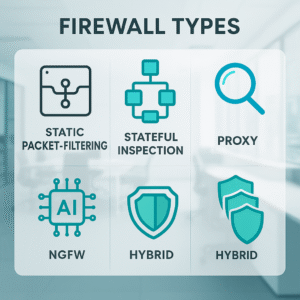
Firewalls have evolved over time to counter increasingly complex cyber threats. Below are the main types of firewalls, each providing a different level of protection.
Static Packet-Filtering Firewall
This is one of the earliest forms of firewalls. It filters traffic based on fixed rules related to IP addresses, ports, and protocols. Operating at the network layer, it checks each packet individually without tracking the state of the connection.
While simple and effective for small systems, it lacks the intelligence to inspect data deeply, making it less suitable for modern, complex networks.
Circuit-Level Gateway Firewall
Operating at the session layer, circuit-level firewalls verify the legitimacy of sessions before allowing connections. Once a connection is approved, data can flow freely until the session ends. However, this continuous connection can sometimes be exploited if attackers gain control during an open session.
Stateful Inspection Firewall
One of the most widely used types today, stateful inspection firewalls track active connections and remember past network interactions. This enables them to identify suspicious patterns in traffic and take action accordingly.
They evaluate packets not only based on headers but also in the context of existing connections, offering much stronger protection than static firewalls.
Proxy Firewall (Application-Level Gateway)
Proxy firewalls work at the application layer and provide deep packet inspection. They act as intermediaries between the user and the internet, evaluating data packets before passing them on.
For instance, if you request access to a website, the proxy firewall retrieves the information on your behalf and delivers it after inspection. This makes it highly secure, though slightly slower due to the intensive inspection process.
Next-Generation Firewall (NGFW)
A next-generation firewall combines traditional firewall features with advanced technologies like intrusion prevention systems (IPS), malware detection, and application awareness.
It can detect modern threats, such as ransomware or data breaches, by analyzing the behavior of applications and users. NGFWs are ideal for large organizations that require extensive protection from sophisticated cyberattacks.
Hybrid Firewall
Hybrid firewalls combine two or more of the above types to deliver multi-layered protection. They are often used in enterprise environments where multiple security approaches are necessary to defend complex infrastructure.
Also Read: What is Data Encryption?
How Firewalls Filter Network Traffic
A key function of a firewall in computer network is filtering network traffic based on certain parameters. It decides whether to block or allow connections based on:
- Source IP address: Determines where the packet originated.
- Destination IP address: Checks where the packet is headed.
- Port number: Identifies the service (e.g., HTTP, FTP, or DNS).
- Protocol type: Examines the rules or “language” used for communication.
- Content inspection: Some firewalls can analyze data within the packet for malicious content.
By applying these rules, firewalls can protect users from harmful websites, phishing attempts, and unauthorized access to confidential data.
The Evolution of Firewalls
The development of firewalls began in the late 1980s and has evolved with advancements in network technology. Early models were basic packet filters that only checked IP addresses and ports. Later, more sophisticated versions introduced concepts like stateful inspection and proxying.
Key figures in firewall history include:
- Brian Reid and Paul Vixie, who developed early packet-filtering technology.
- Marcus Ranum, who created one of the first application-layer firewalls.
- Gil Shwed, who invented the concept of stateful inspection, leading to the creation of Check Point’s Firewall-1 in the early 1990s.
Over time, firewalls have grown smarter and more efficient, integrating artificial intelligence, real-time threat analysis, and cloud-based monitoring.
Why Firewalls Are Important
The importance of firewalls cannot be overstated. In today’s world, where cyber threats evolve daily, having an active firewall is essential for maintaining network security.
Some of the main reasons why firewalls are critical include:
- Protection against unauthorized access: Firewalls prevent hackers and malicious software from entering your network.
- Monitoring and logging traffic: Firewalls keep records of all attempted connections, helping detect unusual behavior.
- Content filtering: Employers or parents can use firewalls to restrict access to specific websites or content.
- Preventing data leaks: Outbound filtering ensures that sensitive data doesn’t leave the network without permission.
- Safeguarding IoT devices: Firewalls can protect smart home devices from being exploited through internet vulnerabilities.
Without a firewall, any computer or network directly connected to the internet is exposed to potential attacks.
What Firewalls Protect Against (and What They Don’t)
Firewalls offer robust protection, but they are not infallible. They can:
- Block unauthorized access to systems.
- Prevent malicious code from entering a network.
- Enforce security policies and manage data flow.
However, they cannot:
- Detect insider threats (malicious actions by authorized users).
- Protect against malware already present on the system.
- Identify human errors or intent behind authorized connections.
Therefore, while a firewall is a powerful first line of defense, it should be combined with other cybersecurity measures such as antivirus software, intrusion detection systems (IDS), and regular security audits.
Real-World Examples of Firewall Applications
The Great Firewall of China
One of the most famous uses of firewalls on a national scale is China’s “Great Firewall.” This massive network security system filters and blocks access to foreign websites, social media platforms, and online content deemed inappropriate by the government. It illustrates how firewalls can be used not only for security but also for content regulation and censorship.
US Federal Agency Breach (2020)
In 2020, a U.S. federal agency experienced a major cyberattack due to a misconfigured firewall. Several ports were left open, allowing unauthorized access. This highlights how even strong firewalls can fail if not properly configured and updated.
US Power Grid Incident (2019)
Another example is the 2019 attack on a U.S. power grid operator. An outdated firewall with an unpatched vulnerability caused a ten-hour network disruption. This incident underlined the importance of regular updates and patch management.
Best Practices for Firewall Protection
To maximize the effectiveness of a firewall, users and organizations should follow best practices such as:
- Regularly updating firewall software and firmware.
- Limiting open ports to only what is necessary.
- Using both network and host-based firewalls.
- Monitoring network activity and analyzing logs.
- Implementing a “deny all” rule as default, only allowing specific trusted connections.
- Segmenting networks to minimize internal spread if a breach occurs.
Regular maintenance and audits ensure that the firewall remains effective against new and emerging threats.
The Role of Firewalls in Modern Cybersecurity
In modern cybersecurity frameworks, firewalls work alongside technologies like VPNs, intrusion detection systems (IDS), and encryption tools. They form part of a multi-layered defense strategy known as “defense in depth.”
As businesses move to cloud computing, firewalls have evolved into cloud-based firewalls or virtual firewalls, which protect data stored on remote servers. The combination of on-premise and cloud-based firewalls ensures end-to-end security across hybrid environments.
Conclusion
To summarize, a firewall in computer network is one of the most critical tools in protecting data, devices, and entire systems from external threats. Whether implemented as hardware, software, or a hybrid solution, firewalls monitor, filter, and control data flow to keep unauthorized access at bay.
Understanding firewall meaning and how it functions allows users and organizations to build a secure foundation for their digital infrastructure. As technology continues to evolve, so do firewalls — becoming smarter, more adaptive, and an essential component of every cybersecurity strategy.

Debabrata Behera is a passionate blogger who writes about digital trends, personal growth, and practical insights, helping readers stay informed, inspired, and ready to achieve success in life.