In today’s digital-first world, data is being generated at an unprecedented speed. Every online transaction, social media interaction, website visit, sensor reading, and system log produces data. However, raw data on its own has very little value unless it can be analyzed, understood, and converted into meaningful insights. This is where data mining plays a crucial role.

Data mining helps organizations, researchers, and governments uncover hidden patterns, trends, and relationships within massive datasets. These insights enable better decision-making, improved efficiency, reduced risks, and competitive advantage.

In this in-depth guide, we’ll explore what data mining is, how it works, why it’s important, and where it’s used, along with its future potential. Whether you’re a beginner or someone looking to understand data mining at a strategic level, this article will give you a complete picture.

What Is Data Mining?
Data Mining

Data mining is the process of analyzing large volumes of data to discover patterns, correlations, trends, and useful information that would otherwise remain hidden. It combines techniques from statistics, machine learning, artificial intelligence, and database systems to transform raw data into actionable knowledge.

The term itself is a bit misleading. You aren’t mining data the way you’d mine coal or gold. You’re mining knowledge from data, and the raw material (rows of numbers, text, timestamps, clicks) is nearly worthless on its own. What makes it valuable is the extraction process: applying algorithms that can sift through millions or billions of records to surface a pattern a human analyst would never spot by eye. A single analyst looking at a spreadsheet of ten thousand customer transactions might notice a rough trend. A clustering algorithm run against ten million transactions can identify seven distinct customer segments, each with different buying triggers, price sensitivities, and churn risk, in a matter of minutes.

In simple terms, data mining answers questions like:

What patterns exist in historical data?
Why did something happen?
What is likely to happen next?
What actions should be taken based on insights?

Unlike basic data analysis, which often focuses on surface-level summaries, data mining digs deeper. It looks for relationships and insights that are not immediately obvious. Basic analysis might tell you that sales dropped 12% last quarter. Data mining tells you that the drop is concentrated among customers who stopped opening your email newsletter forty-five days before they churned, and that this pattern repeats across three other customer cohorts, which gives you something you can actually act on.

Key Objectives of Data Mining

Identify patterns and trends in data: this is the foundational objective, since every other goal depends on first detecting structure in what looks like noise.

Predict future outcomes: once a pattern is confirmed, it can be projected forward to estimate what is likely to happen, whether that’s a customer canceling a subscription or a machine part failing.

Improve business and operational decisions: insights are only useful if they change what a person or system actually does next, so this objective ties mining directly to decision-making processes.

Detect anomalies and unusual behavior: many of the highest-value applications of data mining, like fraud detection, exist specifically to catch the data points that don’t fit the expected pattern.

Support strategic planning: beyond day-to-day operations, data mining feeds long-range planning by revealing shifts in customer behavior, market conditions, or operational risk before they become obvious.

Data mining is widely used in business, healthcare, finance, cybersecurity, marketing, and scientific research, and the underlying techniques transfer across these fields even though the specific questions being asked differ enormously.

How Does Data Mining Work?

How Does Data Mining Work

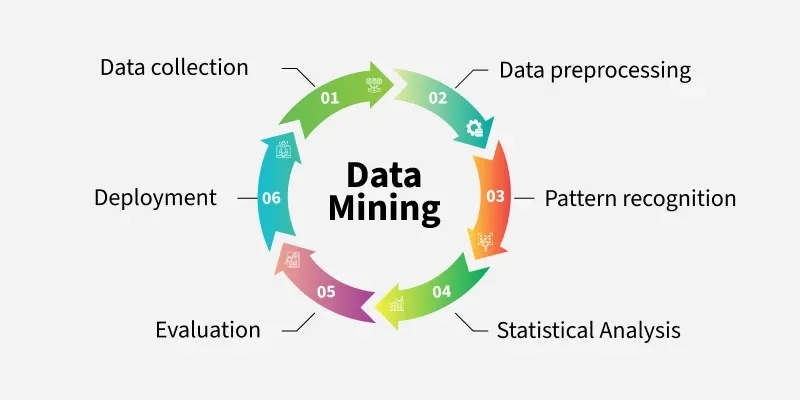
The data mining process follows a structured approach to ensure accuracy, relevance, and reliability of insights. While tools and techniques may vary, the core workflow remains largely the same. It’s often described using the CRISP-DM framework (Cross-Industry Standard Process for Data Mining), and the six stages below map closely to that structure.

1. Data Collection

The process begins with gathering data from various sources such as:

Databases
Data warehouses
Transaction records
Sensors and IoT devices
Websites and applications
Social media platforms

The quality and relevance of collected data directly impact the success of data mining. This stage is where most projects quietly succeed or fail. If the data being pulled doesn’t actually reflect the behavior you’re trying to understand, no algorithm downstream can fix that. A retailer trying to model customer loyalty but only pulling online transaction data, while ignoring in-store purchases, will build a model on an incomplete picture of the customer and get misleading results. Good practice at this stage means documenting where each dataset comes from, how frequently it updates, and what its known limitations are before a single algorithm is applied.

2. Data Cleaning and Preparation

Raw data is often incomplete, inconsistent, or noisy. This step involves:

Removing duplicate or irrelevant records
Handling missing values
Correcting errors
Standardizing formats

Clean data ensures accurate results during analysis. This is also, by most industry estimates, the most time-consuming part of any data mining project, often taking up sixty to eighty percent of total project time. Missing values alone require a decision: do you drop the incomplete records, fill them with an average, or use a model to estimate what the missing value likely was? Each choice changes the outcome. Standardizing formats matters more than it sounds. A date field that mixes MM/DD/YYYY and DD/MM/YYYY formats, or a country field that stores “USA,” “U.S.,” and “United States” as three separate values, will silently corrupt any pattern-detection algorithm applied on top of it.

3. Data Integration

Data may come from multiple systems. Integration combines datasets into a unified view, making analysis more comprehensive and meaningful. In practice this means matching records across systems that may not share a common identifier: a CRM system might identify a customer by email, while a billing system identifies the same customer by account number. Integration involves resolving these mismatches, deduplicating overlapping records, and reconciling conflicting values (like two different addresses for the same customer) so the analysis stage is working from one coherent version of the truth rather than several contradictory ones.

4. Pattern Discovery

This is the core stage of data mining. Algorithms are applied to identify:

Trends
Clusters
Associations
Classifications

These patterns reveal insights that can guide decisions. Different algorithms are suited to different questions. Clustering algorithms, such as k-means, group similar records together without being told in advance what the groups should look like, which is useful for customer segmentation. Association rule mining, the technique behind “customers who bought this also bought that,” looks for items that frequently co-occur. Classification algorithms, like decision trees or logistic regression, assign records into predefined categories, such as marking a transaction as “likely fraud” or “not fraud” based on patterns learned from past labeled examples. Choosing the right algorithm for the right question is one of the more technical skills in this stage, and using the wrong one can produce a pattern that’s statistically real but practically meaningless.

5. Evaluation and Interpretation

Not all patterns are useful. This stage filters results to identify insights that are valid, relevant, and actionable. A dataset with enough variables will always produce some correlations purely by chance. This is where domain expertise becomes essential: a data scientist might find that ice cream sales and drowning incidents rise together, but a domain expert immediately recognizes both are driven by a third factor (hot weather) rather than one causing the other. Evaluation also involves testing whether a pattern holds up on new data the model hasn’t seen yet, since a pattern that only exists in the training data is often just noise dressed up as a signal.

6. Knowledge Presentation

The final step presents insights in a usable form, such as:

Dashboards
Reports
Visualizations
Predictive models

These outputs help decision-makers understand and act on the findings. The best pattern discovery in the world is useless if it stays buried in a data scientist’s notebook. Presentation choices matter: a sales director needs a dashboard with a clear trend line and a plain-language recommendation, not a table of regression coefficients. This stage is also where predictive models get operationalized, meaning they’re wired into live systems so that, for example, a fraud score gets calculated automatically every time a new transaction comes through, rather than being recalculated manually once a month.

Types of Data Mining

Data mining techniques can be grouped based on their purpose. The three most common categories are descriptive, predictive, and prescriptive modeling.

Descriptive Modeling

Descriptive modeling focuses on understanding what has already happened by summarizing historical data.

Key Characteristics
Identifies patterns and relationships
Explains past behavior
Provides insights into data structure

Examples
Customer segmentation based on purchase history
Website traffic analysis
Sales performance summaries

Descriptive data mining helps organizations understand their current state and historical trends. It’s the foundation everything else is built on, since you can’t predict what’s going to happen or prescribe what to do about it until you have a clear, accurate picture of what already happened. A retail chain running descriptive analysis on last year’s sales might discover that 70% of revenue comes from just 15% of SKUs, a pattern that on its own doesn’t predict anything but immediately reshapes how inventory and shelf space get allocated.

Predictive Modeling

Predictive modeling focuses on what is likely to happen in the future. It uses historical data to build models that forecast outcomes.

Key Characteristics
Uses statistical and machine learning algorithms
Estimates future trends and probabilities
Supports proactive decision-making

Examples
Predicting customer churn
Forecasting product demand
Identifying credit risk

Predictive data mining allows businesses to anticipate events instead of reacting to them. The core mechanism is training a model on historical examples where the outcome is already known (customers who did or didn’t churn, loans that were or weren’t repaid) so it learns which combinations of features tend to precede which outcomes. Once trained, the model can score new, unseen cases and assign a probability, such as an 82% likelihood that a given customer cancels their subscription in the next thirty days, which gives a support team the chance to intervene before it happens rather than finding out after the fact.

Prescriptive Modeling

Prescriptive modeling goes a step further by recommending what actions should be taken.

Key Characteristics
Combines predictive insights with decision logic
Evaluates multiple scenarios
Suggests optimal solutions

Examples
Recommending pricing strategies
Optimizing supply chain operations
Suggesting personalized offers to customers

Prescriptive data mining helps organizations choose the best possible course of action. It builds directly on top of predictive output by adding an optimization layer: instead of just telling you a customer is 82% likely to churn, a prescriptive system evaluates several possible interventions (a discount offer, a personal outreach call, a loyalty upgrade) and estimates which one produces the best outcome given the cost of each option. This is the layer that turns a forecast into an instruction, and it’s the least mature of the three types in most organizations because it requires both reliable predictive models and clearly defined business rules or optimization logic on top of them.

Why Is Data Mining Important?

The importance of data mining lies in its ability to convert massive amounts of data into meaningful insights that drive value.

1. Better Decision-Making

Data mining provides evidence-based insights, reducing reliance on guesswork and assumptions. Decisions made on intuition alone tend to reflect whoever has the loudest opinion in the room. Decisions grounded in mined patterns can be tested, quantified, and revisited when new data comes in, which makes the reasoning behind a choice something that can be examined and improved rather than just defended.

2. Improved Efficiency

Organizations can identify inefficiencies and optimize processes using data-driven insights. A logistics company mining delivery route data might discover that a specific warehouse consistently causes delays during a particular shift, an inefficiency that would be nearly invisible in aggregate performance reports but shows up clearly once the data is broken down and mined at a granular level.

3. Risk Reduction

Data mining helps detect anomalies, fraud, and potential threats early. Fraud detection systems built on data mining techniques work by learning what a normal transaction pattern looks like for a given account, then flagging deviations from that pattern in near real time, which is how a bank can catch a stolen card being used in a different country within minutes rather than waiting for the customer to notice the charge on a statement.

4. Competitive Advantage

Companies that leverage data mining effectively can:

Understand customers better
Anticipate market trends
Innovate faster

The advantage compounds over time. A company that starts mining customer data earlier accumulates a longer history of patterns to learn from, which generally makes its predictive models more accurate than a competitor starting from scratch, and that accuracy gap tends to widen rather than close as both companies keep collecting data.

5. Personalization

Data mining enables personalized experiences by analyzing user behavior and preferences. Recommendation engines, the kind that suggest a next product, show, or article, run on association and predictive mining techniques applied to browsing and purchase history. The reason these systems get more accurate the longer you use a platform is straightforward: more behavioral data means the underlying model has more examples to learn the pattern from.

Use of Data Mining

Data mining is applied across a wide range of industries.

1. Business and Marketing

Customer segmentation
Campaign optimization
Sales forecasting

Marketing teams use clustering to break a customer base into segments with distinct behaviors, then tailor messaging, offers, and channel choices to each segment rather than sending one generic campaign to everyone.

2. Finance

Fraud detection
Risk assessment
Credit scoring

Banks and lenders mine historical repayment data to build credit scoring models that estimate the likelihood a new applicant will repay a loan, which is a direct, high-stakes application of predictive modeling.

3. Healthcare

Disease prediction
Treatment optimization
Medical research

Hospitals and research institutions mine patient records and clinical trial data to identify risk factors for disease, evaluate which treatments produce better outcomes for which patient profiles, and accelerate research by surfacing correlations across thousands of records that a single researcher could never review manually.

4. Cybersecurity

Intrusion detection
Threat analysis
Anomaly detection

Security systems mine network traffic logs to establish a baseline of normal activity, then flag deviations, such as an unusual login location or a sudden spike in data transfer, that may indicate a breach in progress.

5. Education

Student performance analysis
Dropout prediction
Personalized learning

Educational institutions mine attendance, grades, and engagement data to identify students at risk of dropping out early enough to intervene, and to tailor course pacing or content to individual learning patterns.

The Future of Data Mining

The future of data mining is closely tied to technological advancements.

1. Integration with AI and Machine Learning

Automation and advanced algorithms will make data mining faster and more accurate. The line between traditional data mining and machine learning has already blurred considerably, with deep learning models increasingly handling pattern discovery tasks that used to require manually tuned statistical methods.

2. Real-Time Data Mining

Organizations increasingly need insights in real time to respond to dynamic environments. Batch processing, where data is mined once a day or once a week, is giving way to streaming architectures that mine data as it’s generated, which matters most in fields like fraud detection and network security where a delayed insight is a useless one.

3. Big Data Growth

As data volumes grow, scalable data mining solutions will become essential. Distributed computing frameworks that can process datasets too large for a single machine are becoming a baseline requirement rather than a specialized tool.

4. Ethical and Privacy Considerations

Responsible data usage, transparency, and compliance will shape future practices. Regulations governing how personal data can be collected and used are tightening in many regions, which means data mining practices increasingly need to account for consent, data minimization, and explainability, not just predictive accuracy.

5. Industry Expansion

Data mining will continue expanding into areas like smart cities, climate research, and advanced cybersecurity, applying the same core techniques of pattern discovery and prediction to problems well beyond its traditional home in business analytics.

Conclusion

Data mining has become an essential tool in the modern digital landscape. As data continues to grow in volume and complexity, the ability to extract meaningful insights is no longer optional, it’s a necessity.

By transforming raw data into actionable knowledge, data mining empowers organizations to:

Make smarter decisions
Improve efficiency
Predict future trends
Reduce risks
Stay competitive

Whether used for business strategy, healthcare innovation, cybersecurity defense, or scientific discovery, data mining plays a critical role in shaping the future of data-driven decision-making.

Understanding what data mining is and why it is important is the first step toward leveraging data as a powerful asset rather than an overwhelming challenge.

Frequently Asked Questions

Where is data mining used?

Data mining is used in business, finance, healthcare, cybersecurity, education, retail, and government sectors, wherever large volumes of historical data can be turned into patterns that inform decisions.

How does data mining work?

It works by collecting data, cleaning it, applying algorithms to find patterns, and presenting insights for decision-making, following a structured process that moves from raw data collection through to a usable output like a dashboard or predictive model.

Why is data mining used?

Data mining is used to discover hidden patterns, predict future outcomes, reduce risks, and support strategic decisions that would be difficult or impossible to make reliably from intuition alone.

What is the difference between data mining and data analysis?

Data analysis typically focuses on summarizing known data to answer a specific, predefined question, while data mining searches large datasets for patterns and relationships that weren’t known in advance. Data analysis tells you what happened; data mining often uncovers why it happened or what’s likely to happen next.

Is data mining the same as machine learning?

Not exactly. Data mining is the broader process of discovering patterns in data, and it often uses machine learning algorithms as one of its tools. Machine learning is a specific set of techniques that allow models to learn from data and improve over time, and it can be applied both inside and outside a traditional data mining workflow.

What skills are needed for data mining?

A data mining practitioner typically needs a working knowledge of statistics, database querying (such as SQL), programming (commonly Python or R), and familiarity with machine learning concepts like classification and clustering. Domain knowledge of the industry being analyzed is equally important for interpreting whether a discovered pattern is actually meaningful.

What tools are commonly used for data mining?

Common tools include Python libraries such as scikit-learn and pandas, R for statistical modeling, SQL for querying structured databases, and specialized platforms like RapidMiner, KNIME, and Weka that provide visual workflows for building mining pipelines without heavy coding.

Is data mining legal?

Data mining itself is legal, but how the underlying data is collected and used is governed by privacy regulations such as GDPR in Europe and various state and national data protection laws elsewhere. Organizations mining personal data generally need proper consent, a lawful basis for processing, and safeguards around how insights are stored and used.

How is data mining different from big data?

Big data refers to datasets that are too large, fast-moving, or complex for traditional data processing tools to handle. Data mining is one of the techniques applied to big data (along with big data storage and processing frameworks) to actually extract useful patterns from it. Big data is the raw material and infrastructure; data mining is one of the processes performed on top of it.

Can small businesses use data mining, or is it only for large enterprises?

Small businesses can use data mining too, often through accessible tools like spreadsheet-based analytics, CRM platforms with built-in reporting, or affordable cloud-based analytics services. The techniques scale down: a small e-commerce store can mine purchase history to spot its best-selling product combinations just as a large retailer would, even without a dedicated data science team.

What is the difference between classification and clustering in data mining?

Classification assigns data into predefined categories based on patterns learned from labeled historical examples, such as marking an email as spam or not spam. Clustering groups data into categories that aren’t predefined, letting the algorithm discover natural groupings on its own, such as identifying customer segments without knowing in advance how many segments exist or what defines them.

How accurate are data mining predictions?

Accuracy depends heavily on the quality and volume of the underlying data, the algorithm chosen, and how well the model is validated against new data it hasn’t seen before. No predictive model is perfect, which is why most organizations track a model’s accuracy over time and retrain it periodically as new data comes in and patterns shift.

What are the biggest challenges in data mining?

The most common challenges are poor data quality, incomplete or biased datasets, the risk of mistaking coincidental correlations for meaningful patterns, and the computational cost of processing very large datasets. Privacy and ethical concerns around how personal data is used add an additional layer of challenge that has grown more significant in recent years.