Identity proofing is the process of confirming that a real-world person matches a claimed identity with a high degree of confidence. As more onboarding and transactions move online, attackers increasingly rely on stolen data, forged documents, and synthetic identities to trick systems that rely only on passwords or basic checks.
Without robust identity proofing, organizations face higher rates of identity fraud, account takeover, and data breaches, along with potential penalties for failing to meet compliance obligations such as KYC and AML requirements. A well-designed proofing process combines multiple signals—documents, biometrics, device data, and behavior—to build strong identity assurance while keeping the user experience as smooth as possible.
What Is Identity Proofing?
Identity proofing is a structured process that collects, validates, and analyzes personal data and evidence to determine whether a claimed identity is real and legitimately belongs to a specific person. This process helps organizations decide whether to trust a new user or re-trust an existing one in higher-risk situations, such as changing credentials or making high-value transactions.
At its core, identity proofing aims to link a digital identity (such as an online account) to a real-world person with a defined level of certainty. To do this, organizations use methods like document checks, biometric comparison, and database lookups to ensure both that the identity exists and that the person presenting it is its rightful owner.
- Identity proofing vs. identity verification vs. authentication
- Identity proofing focuses on establishing a person’s identity at the start of a relationship, such as during account opening.
- Identity verification often refers to validating specific evidence (for example, checking a passport’s authenticity or matching a selfie to an ID photo) as part of the broader proofing process.
- Authentication happens after proofing; it is the ongoing process of confirming that the same, already proofed user is returning, often using passwords, tokens, or biometrics.
- How identity proofing fits into digital identity
- Identity proofing is a foundational step in digital identity frameworks and is closely tied to identity and access management (IAM) and customer IAM (CIAM) systems.
- Once proofing is successful, the system typically creates an account and binds authenticators (such as biometric templates or security keys) that will be used later for secure authentication.
How Does the Identity Proofing Process Work?

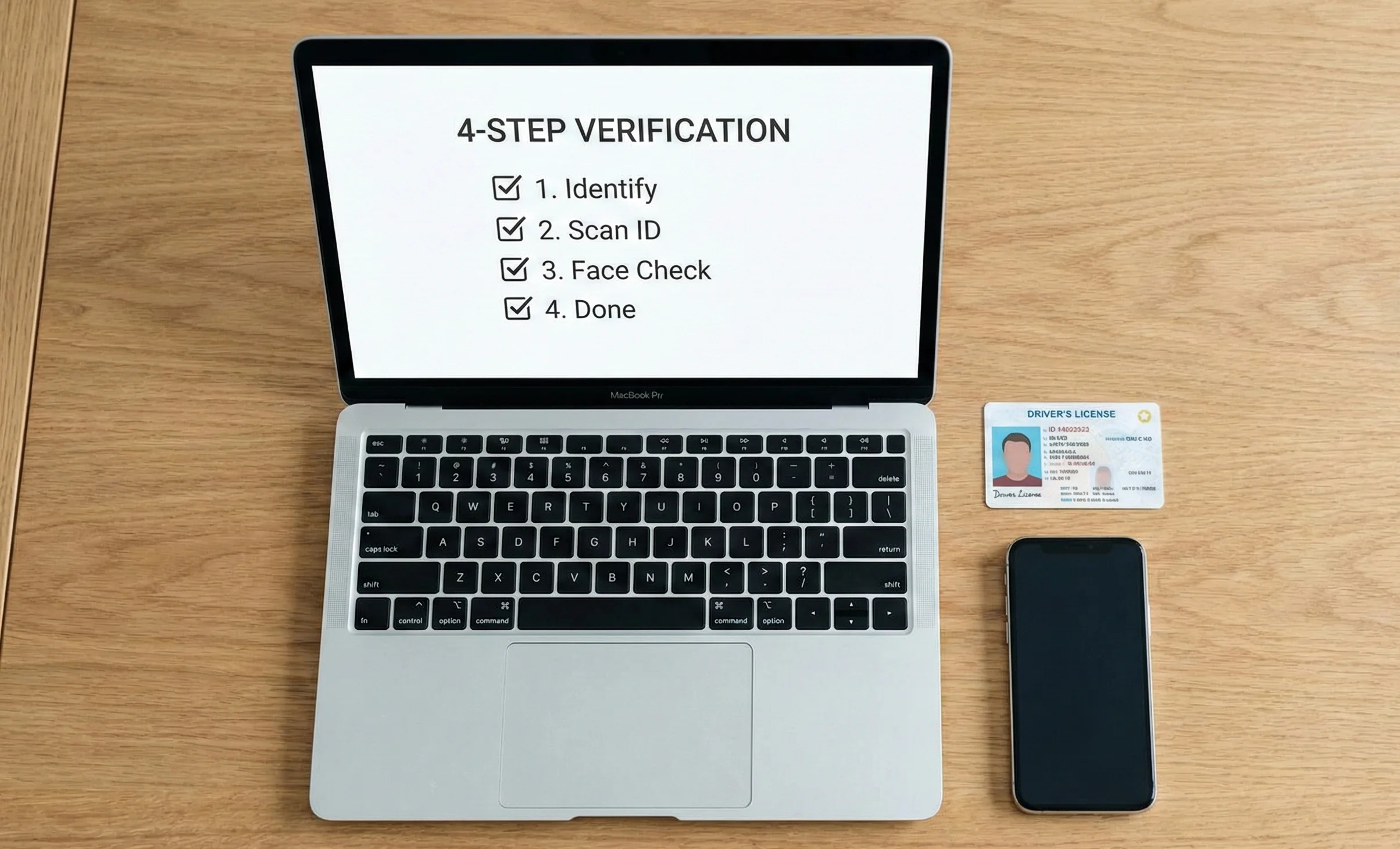
The identity proofing process can vary by industry and risk level, but most mature approaches follow a similar set of steps that include collecting data, validating evidence, confirming the person, and making a risk-based decision. Many standards and providers describe these phases using related models of resolution, validation, and verification.
Step 1: Identity data collection and resolution
In the first step, the organization gathers enough information to form a clear, unique identity profile for the applicant. This often includes personal identifying information such as full name, date of birth, address, and government-issued identifiers, along with copies or scans of official documents and sometimes biometric samples.
- Typical data and evidence collected
- Government-issued documents like passports, national ID cards, and driver’s licenses.
- Biometric data such as facial images, fingerprints, or other traits, especially in higher-assurance use cases.
- Digital signals like email, phone number, device identifiers, IP location, and previous account history when available.
- Role of identity resolution
- Identity resolution involves organizing the collected attributes to determine whether they correspond to a single, distinct individual and are not conflicting or obviously fabricated.
- This step helps detect inconsistencies (such as mismatched names or unrealistic dates) early and prepares the data for validation and risk checks.
Step 2: Validation of identity evidence
Validation focuses on testing whether the provided documents and data are genuine, accurate, and up to date. Automated systems and manual reviewers look for signs of tampering, fabrication, or outdated information that might weaken confidence in the claimed identity.
- Document and data validation checks
- Examining physical or digital security features such as holograms, microprinting, fonts, and machine-readable zones on IDs.
- Using optical character recognition and database queries to confirm that document details follow expected formats and match official records.
- Cross-checking personal data against trusted sources like government registries, credit bureaus, or watchlists, depending on regulations and consent.
- Importance of strong validation
- Effective validation is critical to detect forged or altered documents and reduce the risk of onboarding synthetic identities that combine real and fake data.
- The depth of validation usually increases with the level of identity assurance required for the service.
Step 3: Verification of the person behind the identity

Once the evidence is validated, the next task is to confirm that the person presenting that evidence is the legitimate owner of the identity. This person-based verification is where biometrics, selfies, and real-time checks play a major role.
- Linking the applicant to the identity
- Biometric comparison techniques such as facial recognition compare a live capture or selfie to the photo on the submitted document.
- Liveness detection helps ensure that the system is interacting with a real person rather than a static photo, video replay, or mask.
- Additional factors like one-time passwords sent to a verified phone number or email can further strengthen the link to the identity.
- Why this step is crucial
- Even valid documents can be misused by impostors, so verifying the person prevents fraudulent actors from leveraging stolen or borrowed credentials.
- Strong person-based verification significantly reduces account takeover attempts during onboarding and recovery flows.
Step 4: Risk assessment and final decision
After data collection, validation, and person verification, the organization evaluates the overall risk to decide whether to approve, escalate, or decline the application. This decision can be fully automated, manual, or a combination of both, depending on the risk policy.
- Risk and decisioning factors
- Rule-based and machine learning models consider signals like document authenticity scores, biometric match confidence, device reputation, and geolocation anomalies.
- The outcome typically falls into a small set of states such as approved, rejected, or sent for manual review when signals are conflicting or borderline.
- Continuous improvement of decision logic
- Over time, organizations refine their decision rules and models using feedback from confirmed fraud cases and false positives.
- This feedback loop helps maintain a balance between catching more fraud and minimizing friction for legitimate users.
Continuous proofing and re-proofing
Identity proofing is not always a one-time event; in many environments, it continues at key lifecycle moments to keep risk under control. Organizations may trigger re-proofing when users change sensitive details or perform higher-risk actions.
- Common re-proofing scenarios
- Account recovery events such as password resets or adding new authenticators.
- High-value or unusual transactions that exceed typical behavior patterns.
- Device changes, location anomalies, or long periods of inactivity that raise risk.
- Advantages of continuous proofing
- Ongoing checks help catch compromised accounts and emerging fraud tactics that may not have been present during initial onboarding.
- Continuous proofing supports a more adaptive, risk-based security posture rather than relying solely on static, one-off checks.
Key Identity Proofing Methods and Technologies

Identity proofing relies on a range of methods that can be used alone or combined into multi-layered strategies. Different techniques have different strengths, trade-offs, and suitability depending on risk, regulatory demands, and user experience expectations.
1. Document-based identity proofing
Document-based proofing uses government-issued identity documents and other official records as primary evidence of a person’s identity. Digital tools now automate much of this process for remote onboarding scenarios.
- Typical documents and checks
- Passports, national ID cards, driver’s licenses, and residence permits are commonly used because they contain standardized security features and photos.
- Systems capture document images or video, read machine-readable zones or chips, and analyze security elements to verify authenticity.
- Strengths and limitations
- Document-based methods are well understood by regulators and align closely with many KYC and AML requirements.
- However, high-quality forgeries and stolen genuine documents remain a challenge, especially without biometric or additional risk signals.
2. Biometric identity proofing
Biometric proofing uses unique physical or behavioral traits to link an identity to a specific individual. Common modalities include facial recognition, fingerprint scanning, and iris or voice-based systems.
- How biometrics support proofing
- Biometrics enable direct comparison between the person present and the image or template associated with the identity, strengthening the assurance that they are the legitimate owner.
- Liveness detection and anti-spoofing technologies help distinguish real users from photos, masks, or deepfake content.
- Benefits and considerations
- Biometrics can improve both security and convenience because users do not need to remember secrets or carry separate tokens.
- Organizations must handle biometric data with special care because of its sensitivity and often face stricter privacy and legal requirements.
3. Digital identity and database checks
Digital identity proofing leverages online signals and authoritative databases to validate identities remotely. This approach is frequently combined with document and biometric methods to increase assurance.
- Common digital signals and sources
- Device intelligence, IP geolocation, and network characteristics can reveal suspicious access patterns or mismatched locations.
- Data from government records, credit bureaus, sanctions lists, and other third-party sources help confirm that a person exists and that their details match trusted records.
- Role in remote onboarding
- Digital checks enable faster, lower-friction proofing because many validations can happen instantly in the background.
- They are especially important in fully digital customer journeys where no in-person inspection is possible.
4. Knowledge-based authentication (KBA)
Knowledge-based authentication asks users questions whose answers are assumed to be known only to the legitimate person. Historically, KBA has been used for both identity proofing and account recovery.
- How KBA works
- Static KBA uses pre-set questions such as previous addresses or known associates based on data from credit or public records.
- Dynamic KBA can generate questions in real time based on a user’s history, such as recent transactions or loan details.
- Why KBA is losing favor
- Large-scale data breaches and data brokerage have made many “secret” answers accessible to attackers.
- As a result, regulators and industry bodies increasingly discourage relying on KBA alone for high-risk proofing.
5. Behavioral and risk-based proofing
Behavioral proofing analyzes how users interact with systems to provide continuous identity assurance. Instead of relying only on static evidence, it evaluates patterns over time.
- Common behavioral signals
- Typing speed and rhythm, mouse movements, and navigation patterns can help distinguish humans from bots and flag unusual behavior.
- Transaction histories and typical usage times or locations provide baselines that make anomalies more visible.
- Benefits of behavioral approaches
- Behavioral signals are difficult for attackers to fully mimic consistently, especially over longer periods.
- They allow organizations to adjust risk scores in real time and trigger additional proofing only when risk increases.
6. In-person vs. remote identity proofing
Organizations can conduct identity proofing face-to-face or remotely, depending on operational needs and regulatory expectations. Each approach has its own trade-offs.
- In-person proofing characteristics
- Trained staff inspect documents and may capture biometrics in a controlled environment, which can support higher assurance levels.
- In-person approaches can be more resource-intensive and less convenient, especially for large, distributed user bases.
- Remote proofing characteristics
- Remote proofing uses digital capture of documents and biometrics via mobile or web interfaces, combined with background checks.
- It scales more easily and supports digital transformation but must rely heavily on strong anti-fraud technologies to match in-person assurance.
Identity Assurance Levels and Compliance Frameworks
Identity assurance levels (IALs) help organizations express how certain they are that a claimed identity corresponds to a real person. These levels are central to frameworks that influence many regulatory and industry practices.
Identity assurance levels (IAL1–IAL3) in practice
Standards describe multiple assurance levels to match different risk profiles and use cases. While details vary across jurisdictions, a three-level model similar to IAL1–IAL3 is widely referenced.
- Overview of IALs
- IAL1 typically involves minimal or self-asserted information, with little or no verification of the identity against trusted evidence.
- IAL2 requires more rigorous verification using accepted identity evidence, such as validated documents or remote checks, often suitable for many regulated online services.
- IAL3 is reserved for high-risk scenarios and generally requires in-person verification or equivalent strong remote procedures, often combined with biometrics.
- Applying IALs to real use cases
- Low-risk services such as basic newsletter sign-ups might remain at IAL1 because the consequences of misuse are limited.
- Financial, government, and healthcare services typically aim for higher assurance levels due to the potential impact of identity theft or fraud.
Regulatory drivers for identity proofing
Many regulations require organizations to implement identity proofing as part of broader risk management and compliance programs. Requirements vary by sector and region but share common goals of preventing financial crime and protecting personal data.
- Common regulatory areas
- Anti-money laundering and know-your-customer regimes require financial institutions to verify customer identities and monitor for suspicious activity.
- Regulations for payments and electronic identification set rules for strong customer authentication and identity assurance.
- Data protection expectations
- Data protection laws expect organizations to limit data collection to what is necessary and safeguard identity information against breaches.
- Regulators often expect clear documentation of how identity proofing is performed and how long data is retained.
Sector-specific expectations
Different sectors face distinct risks and therefore adopt different identity proofing strategies. However, the need to balance strong assurance with user experience is common across industries.
- High-exposure industries
- Financial institutions, telecom providers, and government agencies typically require stronger identity proofing because they handle sensitive assets and data.
- Healthcare organizations also need solid proofing to protect medical information and prevent fraudulent claims.
- Emerging digital services
- Online-only banks, fintechs, and digital-native businesses often rely heavily on remote, automated proofing solutions to support fast onboarding.
- High-risk digital services such as crypto exchanges and online lending add extra layers of checks due to heightened fraud and regulatory scrutiny.
Use Cases: Where Identity Proofing Delivers the Most Value
Identity proofing is relevant wherever organizations must trust that users are who they claim to be, particularly before granting high-impact access. Strong proofing is especially valuable when identities connect to financial assets, government services, or sensitive personal data.
Customer onboarding in banking and fintech
Banks and fintech companies rely on identity proofing to meet KYC and AML requirements during customer onboarding. Digital channels have pushed these processes online, increasing reliance on remote document and biometric verification.
- Typical banking scenarios
- Opening checking, savings, or investment accounts often involves document submission and automated checks to ensure the customer’s identity is genuine.
- For higher-value accounts or cross-border services, additional evidence and higher assurance may be required.
Employee and contractor onboarding
Organizations also need to proof identities for their workforce, particularly for roles that handle sensitive systems or data. Strong proofing reduces the risk of insider threats and misuse of credentials issued to the wrong individual.
- Workforce-focused proofing
- Background checks, document verification, and in some cases biometrics, help link digital accounts to verified individuals.
- Identity proofing integrates with access control and IAM systems to ensure only authenticated, verified users can reach protected resources.
Government and e-government services
Government agencies increasingly offer digital services, making remote identity proofing a necessity. These services often involve sensitive benefits or rights, so assurance requirements can be high.
- Government use cases
- Citizen portals for tax filing, benefits applications, and official records rely on identity proofing to prevent fraud and unauthorized access.
- National digital identity schemes often incorporate standardized proofing processes to establish reusable identities for multiple services.
Healthcare and insurance
In healthcare, identity proofing protects access to medical records and reduces the risk of fraudulent claims. Correctly linking records to individuals is critical for both patient safety and regulatory compliance.
- Health-related applications
- Patient portals and telehealth services use proofing to confirm that only legitimate patients can access their data and interact with providers.
- Insurers apply proofing to verify policyholders and reduce identity-based abuse in claims processing.
E-commerce and marketplaces
E-commerce platforms and marketplaces use identity proofing to build trust between buyers, sellers, and the platform itself. While not all purchases require strong proofing, certain activities and roles do.
- Platform trust measures
- Merchant or seller onboarding processes may include document and business identity checks to prevent fraudulent storefronts.
- Higher-risk activities like high-value sales or payouts can trigger additional proofing checks.
High-risk online services

Certain digital services operate in inherently high-risk environments and therefore rely heavily on identity proofing. This includes industries where large sums or valuable digital assets are at stake.
- Examples of high-risk services
- Crypto and digital asset platforms often adopt advanced proofing to meet regulatory obligations and curb fraud.
- Online lending and gaming platforms may implement stronger proofing to prevent abuse and ensure compliance with age or jurisdiction rules.
Benefits of Strong Identity Proofing
Strong identity proofing delivers benefits that extend beyond fraud reduction, improving trust, compliance posture, and user experience when implemented thoughtfully. These benefits are particularly visible at scale in regulated or high-risk sectors.
1. Reducing identity fraud and account takeover
Identity proofing helps detect stolen, synthetic, and fabricated identities before they gain access to systems or funds. Combining document checks, biometrics, and risk analytics makes it harder for attackers to pass as legitimate users.
- Fraud reduction outcomes
- Early rejection of suspicious applicants lowers losses from fraudulent accounts, mule activity, and chargebacks.
- Strong onboarding proofing also makes it harder for attackers to exploit weak account recovery processes.
2. Strengthening security and trust
Users are more likely to trust organizations that clearly protect their accounts and data. Identity proofing shows that an organization takes identity-related risks seriously and helps prevent unauthorized access.
- Trust-enhancing effects
- Verified user populations reduce the likelihood of abusive or criminal behavior, making platforms safer for all participants.
- Strong proofing often pairs with strong authentication, creating a more resilient overall security posture.
3. Supporting compliance and auditability
Effective identity proofing supports regulatory compliance and provides the documentation needed for audits. Detailed records of how identities were verified can be crucial in regulated industries.
- Compliance advantages
- Meeting KYC, AML, and sector-specific identity requirements reduces the risk of fines and enforcement actions.
- Clear audit trails of proofing steps demonstrate due diligence during regulatory reviews.
4. Improving user experience when done right
Carefully designed proofing processes can reduce friction while maintaining security. Modern tools allow many checks to run in the background or within intuitive mobile flows.
- Experience-focused benefits
- Automated document capture, real-time feedback, and mobile-friendly interfaces reduce the time and effort needed to complete verification.
- Risk-based approaches minimize extra steps for low-risk users while reserving more intensive checks for higher-risk cases.
5. Enabling digital transformation and remote services
Identity proofing is a key enabler for moving high-risk interactions online. Without strong remote proofing, many organizations would be forced to keep processes in-person or on paper.
- Transformation outcomes
- Secure remote proofing lets organizations onboard customers and employees without physical branches or offices.
- This capability supports new digital products, wider geographic reach, and more flexible working models.
Challenges and Risks in Identity Proofing
Despite its benefits, identity proofing also introduces challenges that organizations must manage carefully. These include user experience trade-offs, privacy concerns, technological limitations, and evolving fraud tactics.
1. Balancing security and user experience
Stronger proofing often adds steps to onboarding, which can lead to user drop-off if not designed well. Finding the right balance is an ongoing challenge.
- UX-related issues
- Complex document capture flows or repeated retries can frustrate users and lead to abandonment.
- Overly rigid processes that do not account for legitimate edge cases may reject good users unnecessarily.
2. Data privacy and storage risks
Identity proofing involves handling sensitive data, including PII and sometimes biometrics, which must be protected rigorously. Breaches involving this data can cause significant harm to both users and organizations.
- Privacy and security concerns
- Collecting more data than necessary increases exposure in the event of a breach and may conflict with data minimization principles.
- Organizations must implement strong encryption, access controls, and clear retention policies to reduce risk.
3. Bias and accuracy issues in biometrics and AI
Biometric systems and AI-driven risk models can exhibit uneven performance across demographics or contexts. If unaddressed, these issues can translate into unfair outcomes.
- Technical and ethical challenges
- Certain biometric algorithms may have higher error rates for specific age groups, skin tones, or other demographic attributes.
- Organizations need ongoing testing and governance to detect and mitigate such disparities.
4. Sophisticated fraud tactics
Attackers continuously adapt their approaches, using advanced tools and stolen data to try to bypass proofing systems. This arms race requires constant vigilance and innovation.
- Evolving fraud techniques
- High-quality document forgeries and deepfake media can make traditional visual checks less reliable.
- Synthetic identities, which blend real and fabricated data, can slip through naive validation if signals are not cross-checked properly.
5. Operational and cost constraints
Building and maintaining robust identity proofing processes requires investment in technology, people, and oversight. Smaller organizations may find this especially challenging.
- Resource-related pressures
- Manual reviews for edge cases can become costly and may not scale without careful optimization.
- Integrating multiple data sources, tools, and vendors adds complexity that must be managed over time.
Best Practices for Implementing Identity Proofing
To get the most value from identity proofing, organizations should adopt practices that align security, compliance, and user experience. A risk-based, layered, and user-centric approach tends to be most effective.
Start with risk-based requirements
Not every user journey needs the same level of identity assurance. Mapping proofing strength to risk helps avoid unnecessary friction.
- Risk-driven design
- Identify which processes involve higher financial, legal, or reputational risk and assign stronger proofing requirements to those flows.
- Lower-risk interactions can remain at lighter levels to keep experiences fast and accessible.
Use multi-layered proofing, not a single control
Relying on just one method—such as documents or KBA—creates single points of failure. Layering multiple signals provides more robust protection.
- Layering techniques
- Combine document checks, biometrics, and device or behavioral analytics to make it harder for attackers to succeed.
- Design rules so that weaker factors are supported by stronger evidence when risk is higher.
Design user-centric verification flows
User experience design is as important as technical accuracy in successful proofing deployments. Intuitive flows improve completion rates and reduce support costs.
- UX best practices
- Offer clear instructions, real-time feedback on image capture, and mobile-optimized interfaces to minimize friction.
- Where possible, allow users to complete proofing in a single, streamlined session.
Embed privacy and security by design
Identity proofing should follow privacy and security principles from the outset rather than as an afterthought. This reduces long-term risks and improves regulatory alignment.
- Privacy- and security-focused measures
- Limit data collection to what is necessary for the defined assurance level and regulatory obligations.
- Implement strong encryption, role-based access controls, and defined retention schedules for identity data.
Monitor, test, and continuously improve
Fraud patterns and user expectations change over time, so static proofing processes quickly become outdated. Ongoing monitoring and experimentation are essential.
- Continuous improvement activities
- Track metrics such as fraud rates, false positives, completion times, and abandonment to understand performance.
- Regularly adjust rules, models, and flows in response to observed issues and emerging threats.
Work with trusted identity proofing providers
Many organizations partner with specialized providers to access advanced technologies and global coverage. Choosing the right partners is an important strategic decision.
- Vendor evaluation criteria
- Assess providers on accuracy, supported document types and regions, biometric capabilities, and integration options.
- Review their security posture, certifications, data handling practices, and track record in regulated sectors.
How to Choose the Right Identity Proofing Solution
Selecting an identity proofing solution requires aligning technical capabilities, security, and business needs. A structured evaluation helps ensure that the chosen approach fits current and future requirements.
Key evaluation criteria
The best solution will vary by organization, but certain criteria are widely relevant. Understanding these factors makes vendor and architecture decisions more informed.
- Core technical considerations
- Coverage of required document types, countries, and languages is critical for global or expanding businesses.
- The strength and accuracy of biometric and liveness technologies, along with fraud detection capabilities, strongly influence security outcomes.
Integration and scalability
Identity proofing must fit smoothly into existing systems and scale with growth. Poor integration can lead to fragmented user journeys and operational overhead.
- Integration priorities
- APIs, SDKs, and pre-built connectors help embed proofing into IAM, CIAM, and onboarding platforms.
- Solutions should accommodate future channels and products without major redesign.
Vendor security and compliance posture
Organizations depend on providers to manage sensitive identity data securely and in line with regulations. Evaluating vendor practices is therefore essential.
- Security and compliance factors
- Certifications, independent audits, and transparent security documentation provide evidence of mature controls.
- Data residency options and privacy practices should align with the organization’s regulatory environment and customer expectations.
Measuring ROI
Identity proofing investments should be assessed in terms of both risk reduction and business impact. Clear metrics help demonstrate value and guide future improvements.
- Typical ROI dimensions
- Reductions in fraud losses, chargebacks, and manual review workloads are direct financial benefits.
- Improved onboarding conversion rates and customer satisfaction can be significant indirect gains.
Conclusion
Identity proofing has become a cornerstone of modern security, enabling organizations to distinguish genuine users from malicious actors before granting sensitive access or privileges. By combining document checks, biometrics, digital signals, and behavioral analytics within a risk-based framework, organizations can reduce fraud, meet compliance requirements, and support seamless digital experiences.
As threats and technologies evolve, treating identity proofing as a continuous, adaptive capability—rather than a one-time hurdle—helps organizations stay ahead of attackers while maintaining user trust in an increasingly digital world.