Cyber threats are no longer limited to simple viruses or random spam emails. Today, organizations face sophisticated attacks that can bypass basic security controls, stay hidden for weeks, and quietly steal sensitive information without triggering obvious alarms. That’s why businesses are increasingly moving beyond traditional cybersecurity tools and adopting more advanced protection models.
One of the most powerful solutions now used by modern organizations is Managed Detection and Response (MDR). If you’ve ever wondered about MDR meaning, what it covers, or how it works, this guide will explain it in a clear and practical way.
In this complete guide, you’ll learn what MDR is, how MDR services operate, what makes it different from antivirus, and why MDR has become essential for companies of every size.
What is Managed Detection and Response (MDR)?
Managed Detection and Response (MDR) is a cybersecurity service designed to continuously monitor systems, detect threats, investigate suspicious activity, and help organizations respond quickly to attacks.
Instead of relying only on software alerts or basic threat notifications, MDR combines technology with real cybersecurity expertise. That means your organization doesn’t just “get warnings,” but also gets guidance and action-ready support when something dangerous is happening.
To put it simply, MDR means ongoing security monitoring with active threat detection and professional response support, usually delivered by an external cybersecurity team that works alongside your internal IT staff.
MDR meaning in simple terms
If you want the easiest mdr meaning, here it is:
MDR is a managed cybersecurity service that detects threats early, investigates them properly, and helps stop them before they cause damage.
MDR isn’t only about prevention. It’s about answering the real questions that matter during an attack, such as:
- Is this activity actually malicious, or just normal behavior?
- How did the attacker get in?
- What systems are affected?
- What should we do right now to stop the threat?
- How do we ensure this doesn’t happen again?
This is why MDR has become such a valuable layer of defense in modern cybersecurity.
Why MDR is important today

Cybersecurity has changed dramatically in the last few years. Businesses now depend heavily on cloud systems, remote work tools, mobile devices, online communication platforms, and third-party applications. While this improves productivity, it also expands the “attack surface,” meaning there are more entry points for cybercriminals.
A few reasons why Managed Detection and Response is now considered essential include:
Remote working has created security gaps
When teams work from home, they connect from personal networks and devices, sometimes without strong protections. This increases the risk of compromised credentials and device infections.
Threats are faster and stealthier
Modern attacks often use advanced methods that can avoid traditional antivirus scanning, such as fileless malware, stealth-based intrusions, and identity-based attacks.
Businesses cannot monitor everything manually
Even mid-sized organizations generate huge volumes of logs, alerts, and data. Without expert monitoring, it’s very easy to miss the early warning signs of an active breach.
Attackers target every business size
It’s no longer true that only big enterprises are attacked. In reality, smaller companies are often targeted because attackers assume they have weaker defenses.
MDR exists to solve these real-world challenges by making detection and response continuous, smarter, and more reliable.
How does Managed Detection and Response work?
Managed Detection and Response works by collecting security data from multiple parts of your organization, analyzing it for suspicious behavior, and taking action when threats are confirmed.
Most MDR services follow a continuous cycle like this:
- Monitor activity across devices and systems
- Detect suspicious behavior using advanced methods
- Prioritize alerts based on real risk
- Investigate incidents to confirm if they’re attacks
- Respond quickly to contain threats
- Assist with remediation and future prevention
This approach ensures threats don’t stay hidden and that organizations get support when it matters most.
Below is a detailed breakdown of how MDR typically works in real environments.
Event prioritizing
One of the biggest reasons organizations struggle with cybersecurity is not because they have “no alerts,” but because they have too many alerts. Many security tools generate hundreds or thousands of notifications, often for minor issues.
This creates a serious problem known as alert overload, where the IT team gets buried in noise and misses the alert that actually matters.
MDR solves this through event prioritizing.
What event prioritizing means in MDR
In MDR, event prioritizing means:
- reviewing security alerts and logs in real time
- filtering false positives
- identifying which events signal genuine threats
- escalating only the most urgent issues
Instead of treating all warnings equally, MDR focuses on what’s truly risky.
For example, these events may be considered high priority:
- a login attempt from an unusual location or device
- multiple failed logins followed by a successful login
- unexpected administrator privilege changes
- suspicious command execution on an endpoint
- unusual file encryption behavior
By prioritizing events properly, MDR helps organizations respond quickly to real threats instead of wasting time on harmless activity.
Threat search
Threat search, often known as threat hunting, is one of the most valuable features of Managed Detection and Response.
Traditional security tools often work like this:
- An attack happens
- A detection rule triggers
- An alert is created
But many real-world cyber threats don’t trigger simple alerts. They remain quiet, blend into normal traffic, and avoid detection.
That’s why MDR includes threat search, which is proactive.
What threat search does
Threat search means MDR analysts actively look for:
- hidden malware behavior
- suspicious user activity
- stealth persistence mechanisms
- command and control signals
- privilege escalation attempts
- signs of lateral movement inside the network
Instead of waiting for obvious warnings, MDR teams search for subtle patterns that suggest a threat is already active.
This is extremely important because many organizations don’t discover breaches until long after the initial entry, often when damage is already done.
Threat investigation
Once MDR detects suspicious behavior, the next step is threat investigation.
Detection alone is not enough. A security alert doesn’t always mean you are under attack. Sometimes the cause could be:
- a legitimate software update
- a normal admin action
- a misconfigured system
- an employee using a new device
- a false positive triggered by harmless activity
This is where investigation becomes critical.
What happens during threat investigation
Threat investigation in MDR typically includes:
Understanding the source of the activity
Analysts verify where the event began. Was it a user device? A server? A cloud workload?
Analyzing the timeline
MDR teams check what happened before, during, and after the suspicious action. This helps confirm whether it’s isolated or part of a larger attack.
Checking the tactics used
Professional attackers follow patterns. MDR investigators identify if behavior matches known attack techniques such as credential abuse, token theft, or privilege escalation.
Validating whether the threat is real
This is one of the biggest values MDR provides. It reduces panic from harmless alerts while ensuring real threats are handled fast.
Threat investigation converts raw signals into clear answers, which helps organizations make the right decisions quickly.
Response assistance
If the investigation confirms malicious activity, MDR provides response assistance to help stop the attack quickly and reduce damage.
This is where MDR becomes different from many security tools that only notify you but do not help you act.
Response assistance can include:
Containment recommendations
For example, isolating an infected endpoint from the network so it cannot spread malware.
Blocking suspicious activity
Such as preventing access from a malicious IP address or disabling a compromised user account.
Guiding internal IT actions
Many organizations want to act fast but don’t know the safest next step. MDR teams provide step-by-step response guidance.
Supporting incident handling workflows
This includes helping teams communicate internally, collect evidence, and avoid mistakes that worsen the impact.
In many situations, response speed is everything. Even a few minutes can be the difference between a small incident and a large breach.
Managed remediation
Stopping the immediate threat is only one part of cybersecurity. The next step is ensuring the attacker cannot return.
That’s why MDR also includes managed remediation, which focuses on cleanup and recovery.
Managed remediation may include:
- removing malicious files and processes
- reversing unauthorized changes
- restoring affected systems
- patching vulnerabilities that allowed entry
- strengthening policies to prevent repeat attacks
- recommending long-term fixes such as MFA enforcement or access controls
The goal is not just to respond, but to restore security and reduce future risk.
How MDR differs from traditional antivirus software

Many people assume antivirus software is enough. While antivirus still has value, modern threats have evolved beyond what traditional antivirus can consistently handle.
Traditional antivirus: what it does
Traditional antivirus mainly focuses on:
- scanning files on a device
- detecting known malware signatures
- blocking recognized threats
- quarantining suspicious files
This can be useful against basic malware, but it has limitations, especially against newer and stealthier threats.
MDR: what it does differently
Managed Detection and Response goes beyond scanning by providing:
Continuous monitoring
MDR watches systems around the clock, not just when a scan is run.
Behavior-based detection
Instead of only checking known file signatures, MDR identifies suspicious behavior patterns that suggest an active intrusion.
Human-led analysis
MDR includes security experts who validate real threats and guide response actions.
Cross-environment visibility
MDR often monitors endpoints, identity activity, servers, cloud systems, and network events together.
So, if you’re trying to understand mdr means in a practical sense, it means security that is active, monitored, investigated, and supported by experts, not just installed as a tool.
MDR vs EDR: What’s the difference?
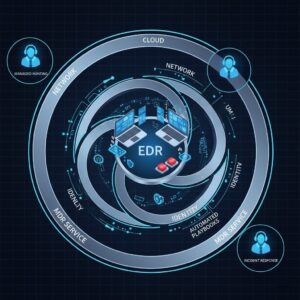
A common question in cybersecurity is the difference between MDR and EDR.
What is EDR?
EDR stands for Endpoint Detection and Response. It is a security tool focused on monitoring endpoints such as laptops, desktops, and servers.
EDR platforms typically:
- collect endpoint behavior data
- detect suspicious activity
- provide alerts
- support response actions on devices
How MDR is different
The key difference is that EDR is a tool, while MDR is a service.
You can think of it like this:
- EDR gives you visibility and detection on endpoints
- MDR gives you experts who monitor, detect, investigate, and respond using tools like EDR (and other systems)
Many organizations buy EDR but struggle to manage it effectively because it requires experienced security analysts.
That’s where MDR becomes valuable, because it provides the expertise and ongoing management that many teams do not have internally.
Is MDR the same as XDR?
Another confusing topic is MDR vs XDR.
What is XDR?
XDR stands for Extended Detection and Response. Unlike EDR, which focuses mainly on endpoints, XDR collects signals from multiple areas like:
- endpoints
- email systems
- cloud workloads
- network traffic
- identity and access activity
MDR vs XDR explained simply
XDR is a technology platform.
MDR is a managed service.
An MDR provider may use XDR as part of their technology stack, but MDR itself is the service model that includes monitoring and response expertise.
Key benefits of Managed Detection and Response
Managed Detection and Response is not just another security layer. It provides business-level advantages that directly reduce risk and improve operational stability.
Reduced detection time
Many attacks stay undetected for a long time because the signs are small and easy to miss. MDR reduces detection time by monitoring continuously and catching suspicious patterns early.
Faster detection often means:
- less data theft
- fewer affected systems
- lower recovery costs
- less downtime
Improved security posture
MDR doesn’t only respond to threats. Over time, it strengthens overall security by identifying weaknesses such as:
- outdated systems
- risky configurations
- weak access management
- unprotected endpoints
- unusual user behavior patterns
This helps organizations improve security maturity.
Continuous threat detection
Threats don’t follow business hours. Attacks can happen at night, on weekends, or during holidays when internal teams are unavailable.
MDR offers continuous monitoring so that threats are not ignored simply because nobody is watching at the time.
Faster threat response and remediation
Speed matters. MDR helps organizations act quickly with:
- clear investigation results
- direct response recommendations
- quick containment actions
- guided remediation support
This reduces the chances of threats spreading and causing major disruption.
Lower security staff burden
Hiring and retaining skilled security experts is expensive and difficult. MDR helps by reducing the workload on internal teams, especially when those teams are already busy with IT support, maintenance, and business operations.
MDR allows internal staff to focus on important work while security experts handle threat monitoring and response.
Minimized risk of alert fatigue
Alert fatigue happens when security teams receive so many warnings that they stop responding properly, or they miss critical incidents.
MDR helps prevent alert fatigue by:
- prioritizing critical events
- filtering false positives
- escalating only real threats
- reducing unnecessary noise
What to look for in Managed Detection and Response services
Not all MDR services provide the same depth of coverage. If you’re comparing options, here are the key areas you should consider.
Additional MDR skills
Strong MDR services should include professionals experienced in:
- threat hunting
- malware behavior analysis
- incident response planning
- log investigation and correlation
- advanced persistent threat detection
- identity-based attack identification
MDR security knowledge and capabilities
A good MDR provider should support modern environments such as:
- Windows and macOS endpoints
- cloud workloads and cloud accounts
- email security monitoring
- network traffic analysis
- identity systems and authentication logs
The broader the monitoring coverage, the better the chance of detecting complex attacks.
MDR service provision and collaboration
Good MDR is not only about tools, it’s about responsiveness and communication.
Look for MDR providers that offer:
- clear communication channels
- fast escalation processes
- ongoing reporting and insights
- collaborative workflows with internal IT teams
- clear explanation of incidents in plain language
Comprehensive solutions
A strong MDR service should support:
- scalability as your business grows
- integration with existing security tools
- customized detection logic for your environment
- long-term prevention recommendations
The right MDR solution should feel like a complete extension of your security operations.
Conclusion
Cyberattacks are becoming more frequent, more targeted, and harder to detect with traditional security solutions alone. Businesses need stronger visibility, faster response capabilities, and expert guidance to stay protected in real time.
That’s exactly what Managed Detection and Response (MDR) delivers.
If you’re searching for MDR meaning, the simplest explanation is that MDR is a managed cybersecurity service that continuously monitors, detects, investigates, and helps respond to threats before they become major incidents.
And if you’re wondering what MDR means in real-world value, it means less guessing during an attack, faster action when something goes wrong, and stronger protection for your systems, data, and users.
FAQs
What is MDR meaning in cybersecurity?
MDR meaning refers to Managed Detection and Response, a cybersecurity service that provides continuous monitoring, threat detection, investigation, and response support to help stop attacks quickly.
MDR means what exactly for businesses?
MDR means a business gets professional security monitoring and response support without needing to build a full in-house security operations team.
Is MDR only for large companies?
No. MDR is useful for businesses of all sizes, especially those that lack internal cybersecurity experts or need stronger monitoring and response capability.
What is the biggest benefit of MDR?
The biggest benefit of MDR is faster detection and response. It helps stop threats early and reduces the damage caused by cyberattacks.
Does MDR replace antivirus?
MDR does not always replace antivirus, but it goes beyond antivirus by detecting advanced threats, investigating incidents, and providing response assistance.
Can MDR prevent ransomware?
MDR can significantly reduce ransomware risk by detecting suspicious behavior early, isolating infected systems, and guiding response actions before widespread encryption occurs.
If you want, I can also write a meta description for this blog and provide featured image prompts that match this topic.

Debabrata Behera is a passionate blogger who writes about digital trends, personal growth, and practical insights, helping readers stay informed, inspired, and ready to achieve success in life.